
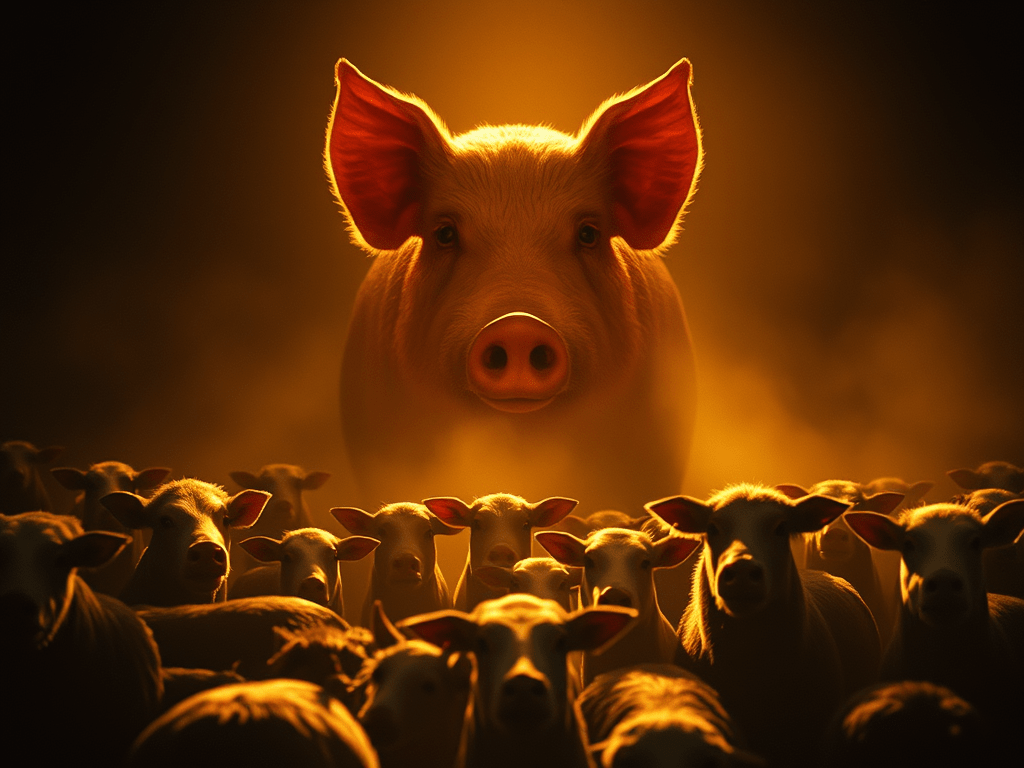
Animal Farm by George Orwell is one of the most widely studied political allegories in modern literature. Published in 1945, the novella looks deceptively simple: a group of farm animals overthrow their human owner and attempt to create a fairer society. Yet beneath this simple story lies a sharp and unsettling critique of power, corruption, propaganda and betrayal.
For students, Animal Farm is not just a story about animals, it is a text about how revolutions begin with hope and end with oppression, and how language and fear can be used to control societies. This article explores the novel’s key themes, characters and messages, while also showing you how to use them effectively in essays and exams.
1. What is Animal Farm really about?
At its core, Animal Farm is an allegory, a story that operates on two levels. On the surface, it tells the story of animals who rebel against their farmer. On a deeper level, it mirrors the events of the Russian Revolution and the rise of a totalitarian state.
Orwell uses the farm to explore big political questions:
- Why do revolutions often fail?
- How does power change those who hold it?
- How can ordinary people be manipulated?
- Why do societies allow injustice to grow?
Understanding this allegorical layer is crucial for high-level exam answers.
2. The dream of equality: The beginning of the rebellion
The story begins with a vision of a fairer society. The animals are inspired to believe they can create a world where:
- Everyone is equal
- Everyone shares the work and rewards
- No one is exploited
At this stage, the revolution represents hope, idealism and unity. This mirrors how many real-life revolutions begin, with genuine belief in justice and fairness.
For students, this is important: Orwell is not saying that the desire for equality is wrong. Instead, he shows how good ideas can be destroyed by bad leadership and human weakness.
3. How power begins to corrupt
After the rebellion succeeds, leadership quickly falls into the hands of the pigs, who are considered the most intelligent animals. At first, this seems practical and sensible. However, this is the first step toward inequality.
Slowly, the pigs:
- Take extra food
- Make decisions without consulting others
- Change the rules to suit themselves
- Separate themselves from the rest of the animals
This shows Orwell’s central warning: power does not just corrupt suddenly, it erodes principles gradually. Each small change seems minor, but together they completely destroy the original ideals of the revolution.
In exam terms, this is a strong example of structural corruption rather than just individual evil.
4. Napoleon and the nature of dictatorship
Napoleon’s rise to power shows how dictatorships are built on fear, violence and control of information. He does not rule because he is loved, he rules because he is feared.
Key methods he uses:
- Violence (using the dogs as enforcers)
- Fear (public executions and threats)
- Lies (rewriting history and rules)
- Isolation (cutting the animals off from outside information)
Orwell is showing that tyranny does not need intelligence or moral authority, only control. This is one of the novel’s most chilling ideas.
5. Propaganda and the control of language
One of the most important themes in Animal Farm is propaganda. The pigs do not just use force, they use words.
Through constant repetition, half-truths and outright lies, the leadership:
- Rewrites the Seven Commandments
- Changes the past
- Makes suffering seem necessary
- Makes privilege seem justified
Over time, the animals begin to doubt their own memories. This shows how dangerous propaganda is: it does not just control what people think, it controls what they believe is real.
For students, this is a brilliant example to use when writing about language, power and manipulation in literature.
6. “All animals are equal… but some are more equal than others”
This line is the ultimate symbol of the novel’s message.
It shows:
- How language can be twisted
- How ideals can be betrayed
- How inequality can be justified
- How hypocrisy becomes normal
The revolution was supposed to remove class divisions, but by the end, society is even more unequal than before. The pigs become indistinguishable from the humans they replaced.
Orwell’s warning is clear: if people stop questioning power, oppression will return in a new form.
7. The working class and silent suffering
Most of the animals represent ordinary people who:
- Work hard
- Believe in the system
- Trust their leaders
- Suffer the consequences
They are loyal, hopeful and patient, but also easily manipulated. Orwell is not mocking them; he is showing how systems of power rely on obedience and exhaustion to survive.
For essays, this links strongly to themes of:
- Exploitation
- Class inequality
- Political ignorance
- The danger of blind loyalty
8. Why Animal Farm is still relevant today
Even though the novel was written in 1945, its ideas remain deeply relevant:
- Governments still use propaganda
- Leaders still rewrite narratives
- Power still concentrates at the top
- Ordinary people still pay the price
That is why Animal Farm is taught all over the world, not just as history, but as a warning about human nature and political systems.
9. How to write top-grade answers on Animal Farm
Strong exam responses usually:
- Explain the allegory clearly
- Analyse how Orwell uses characters and events symbolically
- Explore language and propaganda
- Link power and corruption to the plot
- Offer critical judgement, not just summary
Remember: examiners reward analysis, not retelling the story.
Study support with Apollo Scholars
At Apollo Scholars, we help students:
- Break down complex texts like Animal Farm
- Build high-level literary analysis
- Structure essays for top marks
- Understand themes, context and language
- Gain confidence in exams and coursework
We offer personalised tutoring and exam-focused support to help students turn good understanding into great results.
Final takeaway
Animal Farm is not just a story about animals or a single historical event. It is a powerful warning about how easily freedom can be lost, how language can be weaponised and how corruption grows when people stop questioning authority.
If you understand its themes of power, propaganda, betrayal and inequality, you are not just revising a novel, you are learning how literature exposes the darkest patterns of human behaviour.

Leave a comment