

Quadratic equations are a core topic in GCSE maths. Mastering how to solve them is essential for boosting your confidence and performance. These equations appear in various real-world problems. In this blog, we’ll explore what quadratic equations are and the different methods you can use to solve them.
Follow us on Instagram, Facebook and LinkedIn.
What is a Quadratic Equation?
A quadratic equation is any equation that can be written in the form:

Where:
- a, b, and c are constants (with a≠0).
- x² represents the squared term.
Quadratic equations usually have two possible answers. When you draw their graph, it forms a U-shaped curve called a parabola. This curve can cross the x-axis at two points (two solutions). It can touch it at one point (one solution). It may also not cross it at all (no real solutions).
Related | Mastering equations: Your guide to success in GCSE Maths
Methods for Solving Quadratic Equations
Factoring
Factoring is a simple method for solving quadratic equations. However, it only works when the equation can be broken down into two binomials. Here’s the basic idea:
For an equation like ax²+bx+c=0
You rewrite it as (dx+e)(fx+g)=0
Then, set each factor equal to zero and solve for x.
For example, in (x−3)(x+2)=0, you get two solutions: x=3 and x=−2.
Completing the Square
This method turns a quadratic equation into a perfect square, which makes it easy to solve. Here’s how:
- Move the constant to the other side of the equation.
- Add the square of half the x-term’s coefficient to both sides.
- Factor the left-hand side into a binomial squared.
- Take the square root of both sides and solve for x.
Example: For x²+6x+5=0,
- First, rewrite as x²+6x=−5.
- Add 9 to both sides: (x+3)²=4.
- Now, solve: x+3=±2, so x=−1 or x=−5.
Quadratic Formula
The quadratic formula works for any quadratic equation. It’s a go-to method when factoring or completing the square isn’t possible. The formula is:
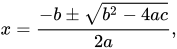
Just plug in the values of a, b, and c from your equation and solve.
For example, in 2x²+4x−6=0:
- a=2, b=4, and c=−6.
- Using the formula:
x = -4±√4²-4(2x-6) / 2(2)
x = 1 or x = -3
Graphing
You can also solve quadratic equations by graphing. For an equation like y = ax²+bx+c, the solutions are where the graph crosses the x-axis. These x-values are the roots of the equation.
However, graphing is typically used to check answers rather than as a primary solving method.
Related | Mastering the art of rearranging equations
Conclusion
Quadratic equations may seem complex, but with the right methods, they become manageable. Learn to factor. Complete the square. Use the quadratic formula. Graph equations. You’ll then be well-equipped to tackle any quadratic problems in your GCSE exams.
At Apollo Scholars, we offer tailored tutoring to help students master these techniques and build confidence in solving quadratic equations. Practice is key, so be sure to apply these methods to different types of problems. With our support, you’ll strengthen your skills and achieve your full potential in GCSE maths.
Book your online or in-person maths tutoring session here.
Unlock our exclusive resources in our Mission Control hub.


Leave a comment