
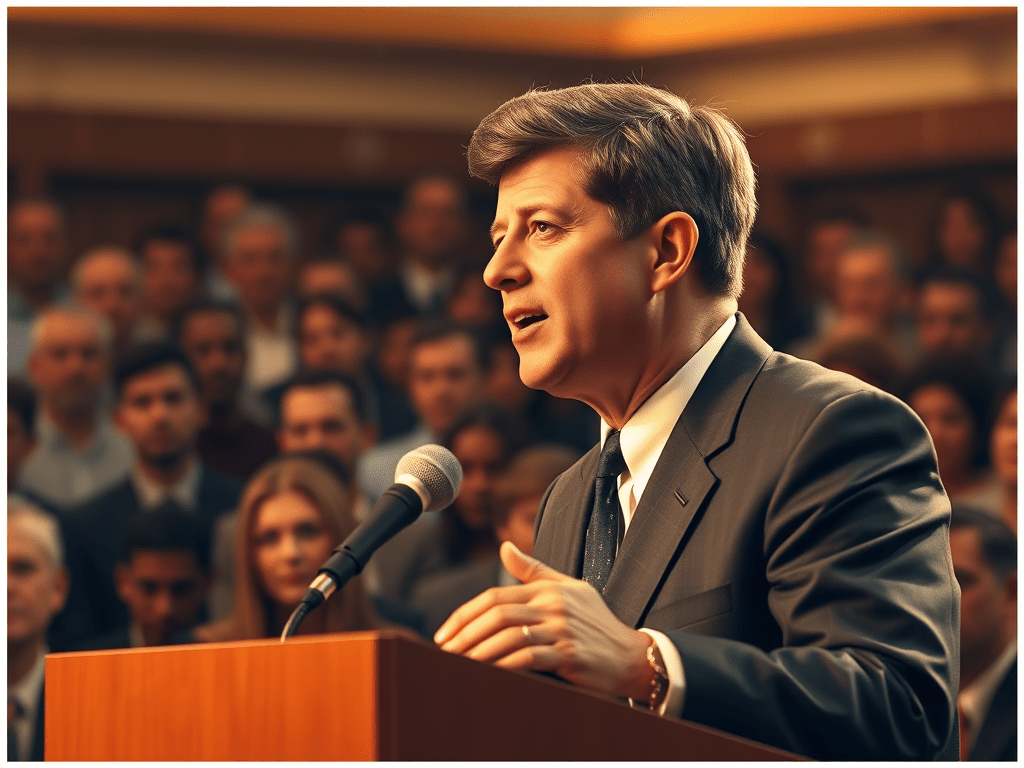
Every speech has the potential to move people. Whether you want to inspire, persuade, or call to action, you need more than good ideas. You need to structure them, present them and connect with your audience. Let’s explore the key ingredients for a compelling speech, with examples from famous orators to help you see what works.
1. Know Your Audience
Before you write a single line, ask yourself:
- Who am I speaking to?
- What do they already believe?
- What do they need to hear from me?
Guidance:
- If your audience already agrees with you, your job is to reinforce their beliefs and inspire them further.
- If they disagree, you need to bridge the gap by showing respect, finding common ground, and gradually persuading.
- Consider age, background and values. A speech to classmates will be very different from a speech to adults.
Example: John F. Kennedy’s Inaugural Address (1961) speaks to Americans as “my fellow citizens.” His repeated use of “we” unites the audience. Read more.
Watch Now – President John F. Kennedy’s Inaugural Address, January 1961
2. Understand the Context
A powerful speech does not float in a vacuum; it belongs to a moment.
Guidance:
- Think about why now: Is there a crisis, a celebration, or a debate?
- What emotions are people feeling – fear, pride, hope, anger?
- Match your tone to the moment: empathetic in a tragedy, bold when setting a vision.
Example: Barack Obama’s Victory Speech 2008.
Watch Now – President-Elect Barack Obama’s 2008 Victory Speech
3. Clarify Your Message
What is the one thing you want your audience to remember?
Guidance:
- Keep your message simple, strong and repeated.
- Use rhetorical devices like repetition, rhetorical questions and contrasts.
- Structure your speech: Introduction (hook), Body (develop main points with evidence or stories), Conclusion (memorable ending and call to action).
Example: JFK’s “We choose to go to the Moon” speech repeats the line “we choose” to hammer home his message of ambition.
Watch Now – John F. Kennedy’s 1962 “Moon Speech”
4. Use Tone and Style Effectively
The way you say things matters just as much as what you say.
Guidance:
- Use emotive language to connect hearts as well as minds.
- Balance logic and evidence with emotional appeal.
- Vary your sentences: short, powerful bursts alongside flowing, descriptive ones.
Example: Malala Yousafzai’s UN speech combines her personal story (emotion) with calls for education (logic). Read here.
5. End with a Call to Action
Your audience should leave with something to do – not just something to think about.
Guidance:
- Be clear: do you want them to vote, change behaviour, support a cause, or simply reflect?
- Make it practical: the more realistic and specific, the more persuasive.
6. Make It Memorable
The best speeches stick in people’s minds.
Guidance:
- Use hooks (a striking fact, a story, or a question) to grab attention at the start.
- Repeat key phrases so they linger.
- Use contrasts like “not this, but that.”
Example: JFK’s famous line, “Ask not what your country can do for you, ask what you can do for your country,” is unforgettable because it flips expectations.
7. Revise and Practice Delivery
Even the best words need strong delivery.
Guidance:
- Edit your speech: remove clutter, keep sentences punchy.
- Practice tone, pauses and emphasis. A pause can be as powerful as a sentence.
- Body language matters: eye contact, hand gestures, posture all reinforce your words.
Step-by-Step Writing Plan for Your Own Speech
- Choose your topic: Pick something you care about (e.g., climate change, school rules, mental health).
- Define your purpose: Do you want to persuade, inspire, or motivate?
- Identify your audience: Who are you speaking to? What matters to them?
- Brainstorm key points: Write 3–4 main ideas you want to get across.
- Plan your hook: Start with a rhetorical question, shocking fact, or short story.
- Develop your argument: Use evidence, examples and rhetorical devices (e.g., “Imagine…”, repetition, emotive language).
- Add contrast or counterargument: Strengthen your case by addressing the other side briefly.
- Craft a call to action: Decide what you want your audience to do or think differently.
- Write your draft: Keep paragraphs focused and sentences varied.
- Revise and practice: Read aloud, cut unnecessary words, practice tone and pauses.
Sample GCSE-Style Speech
Task: Write a speech for your classmates persuading them that social media does more harm than good.
Speech:
“Imagine waking up every morning to a chorus of voices telling you that you are not good enough. That is what social media can feel like. A thousand filters, a thousand comparisons and a thousand chances to feel small.”
We were told social media would connect us, but I ask you this: are we truly connected, or are we more isolated than ever? Studies show that teenagers who spend more than three hours a day online are more likely to suffer from anxiety and depression. That is not connection. That is harm.
Yes, social media can inform us. It can make us laugh. But at what cost? Our confidence? Our time? Our peace of mind? We must ask ourselves: do we control social media, or does it control us?
So what should we do? We cannot simply delete the internet. But we can take action. Limit your time online. Value face-to-face conversations. Remember that what you see on a screen is not reality. Choose to put your health and happiness first.
So I leave you with this: social media is powerful, but so are we. Let’s take back control – for our minds, our friendships and our future.
Tips for GCSE Success
When writing for GCSE English Language:
- Use rhetorical devices.
- Think about context – why this speech, why now?
- Vary sentence length and punctuation for effect.
- Use clear paragraphs: each should focus on one main idea.
Final Thought
Writing a speech is about more than putting words on a page. It is about understanding your audience, respecting the context, crafting a clear message and making people feel and act. Whether you are aiming to persuade examiners or inspire classmates, remember: a great speech is not just heard, it is remembered.https://www.youtube.com/embed/0GKd50lrROc?si=hcnQ_NA8aSBqSAGY

Leave a comment