
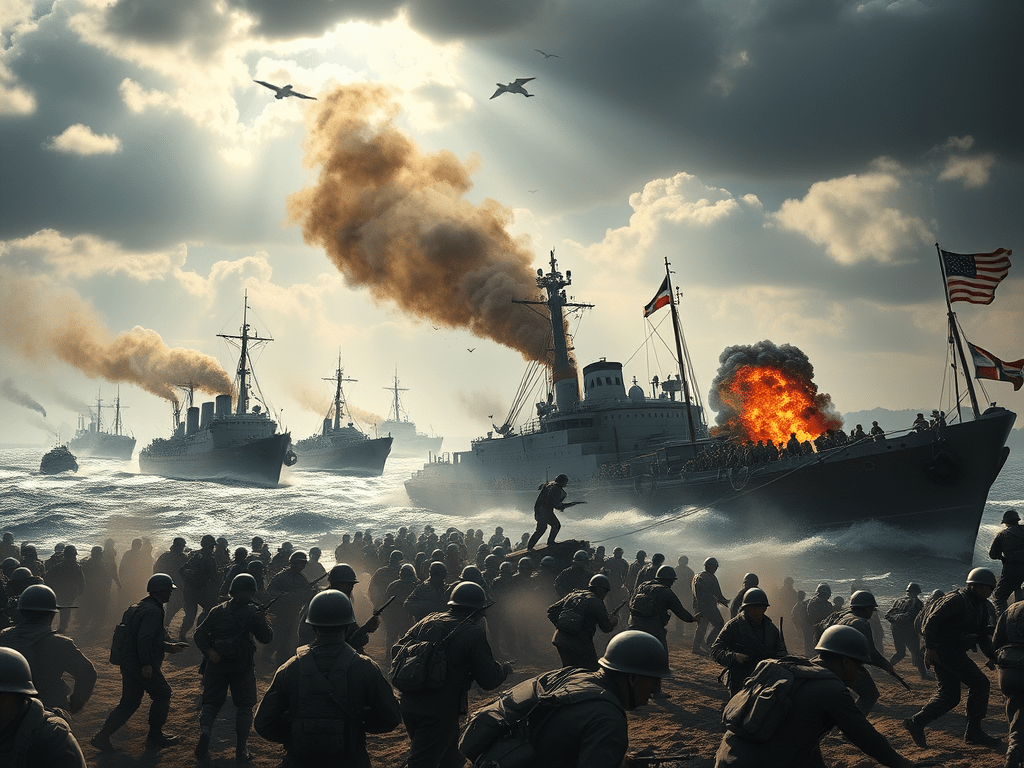
What Was the Dunkirk Evacuation?
The Dunkirk evacuation, also called Operation Dynamo, took place between 26 May and 4 June 1940, rescuing over 338,000 Allied soldiers from northern France. Surrounded by German forces and under constant bombardment, the British Expeditionary Force (BEF), along with French and Belgian troops, was evacuated in what Winston Churchill famously described as a “miracle of deliverance.”
Why it matters: Dunkirk is a key example of strategic retreat, leadership under pressure and national morale during WWII.
Why Did Dunkirk Happen? Historical Context
By May 1940, Germany had conquered Belgium, the Netherlands, and much of northern France using blitzkrieg tactics. The Allies were trapped along a narrow strip of coastline around Dunkirk.
Key factors leading to the evacuation:
- Rapid German advances caught the Allies unprepared
- British and French forces were surrounded by German troops
- The fall of France seemed imminent, leaving the evacuation as the only option to save the core of the Allied forces
How Many Soldiers Were Evacuated at Dunkirk?
Operation Dynamo rescued over 338,000 soldiers, including British, French and Belgian troops. While the evacuation was a retreat, it preserved the bulk of Britain’s military forces, enabling the country to continue fighting in WWII.
Operation Dynamo: Step-by-Step Evacuation Plan
The operation was coordinated by Vice Admiral Bertram Ramsay at Dover and involved:
- Royal Navy ships transporting soldiers from beaches and harbours
- Civilian “Little Ships” ferrying troops across the English Channel
- Royal Air Force (RAF) providing air cover against German Luftwaffe attacks
Timeline of the evacuation:
- 26 May 1940: Operation Dynamo begins
- 27–28 May 1940: Evacuations continue; German advance temporarily slows
- 29–31 May 1940: Mass rescues, with thousands saved daily
- 1–2 June 1940: Final groups of troops evacuate; civilians continue crossing Channel
- 4 June 1940: Operation concludes successfully
Who Were the Key Figures at Dunkirk?
Winston Churchill: Framed the evacuation as a symbol of resilience and unity, boosting public morale through speeches.
Vice Admiral Bertram Ramsay: Oversaw naval coordination, ensuring as many troops as possible were evacuated.
Royal Air Force Pilots: Defended evacuation ships from Luftwaffe attacks, often at heavy cost.
Charles Lightoller: Titanic survivor and veteran mariner who piloted civilian vessels, demonstrating heroism and expertise during the evacuation.
How Did Civilians Help During Dunkirk?
The “Little Ships”, private yachts, fishing vessels, and ferries, played a vital role in rescuing troops. Civilians risked their lives, showing national solidarity and courage.
What Were the Challenges at Dunkirk?
- German artillery and air bombardment
- Soldiers stranded on open beaches, wading into the sea to reach boats
- Limited resources and chaotic coordination between military and civilian vessels
Despite these challenges, over 338,000 troops were evacuated, highlighting improvisation and leadership under pressure.
Military Significance of Dunkirk
Though not a battlefield victory, Dunkirk had critical strategic impact:
- Preserved the core of the British Army
- Boosted morale in Britain and the Allies
- Delayed German plans, enabling preparation for the Battle of Britain
Psychological and Cultural Impact
Churchill’s speeches after Dunkirk reframed it as a symbol of hope and unity:
- “We shall fight on the beaches… we shall never surrender.”
Dunkirk in popular culture:
- 2017 film Dunkirk: Directed by Christopher Nolan, emphasising human endurance and heroism
- Books, documentaries and memorials continue to celebrate Dunkirk as an iconic moment in British history
Lessons from Dunkirk for Students
- Strategic retreats can preserve lives and military capability
- Effective coordination and improvisation are critical in crisis
- Civilians can play a decisive role in national survival
- Leadership is about morale, symbolism and strategy, not just battlefield victories

“Dunkirk teaches that courage, leadership and quick thinking can turn a potential disaster into a defining moment. The bravery of soldiers, pilots and civilian sailors alike shows how collective effort shapes history. For students, studying Dunkirk reveals how strategy, morale and unity can overcome overwhelming odds.”
Matt
Founder, Apollo Scholars


Leave a comment