
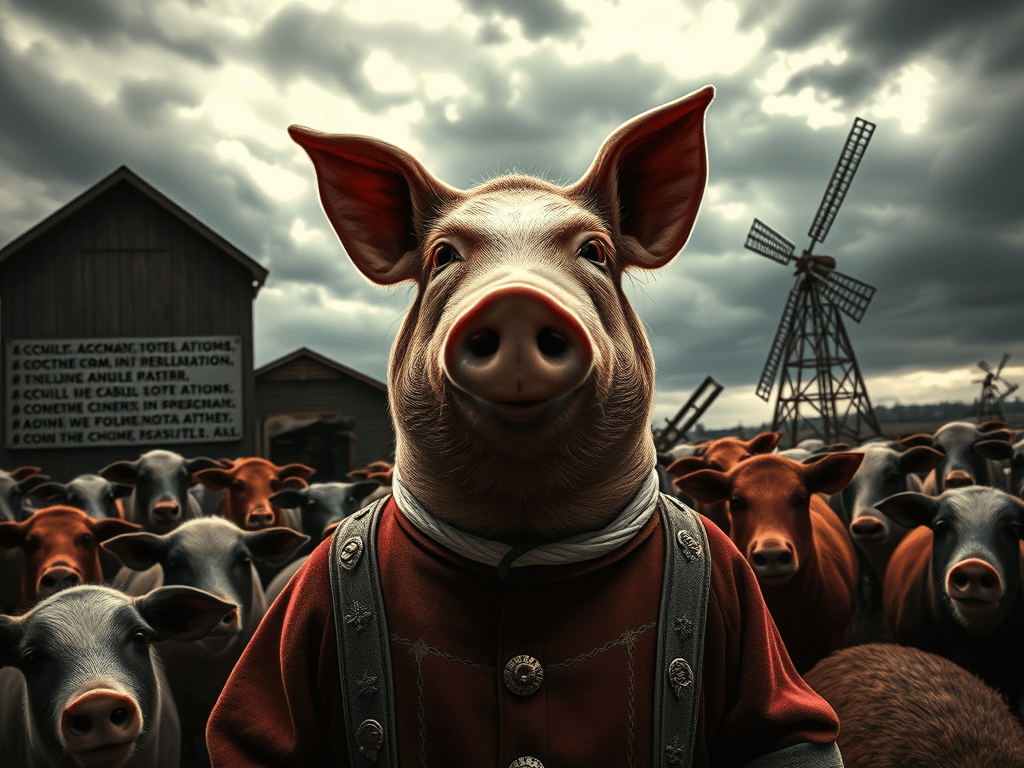
Unlock the Apollo Scholars Exclusive Animal Farm GCSE Revision Guide
Before diving into Chapter 8, make sure you have the Apollo Scholars Exclusive Animal Farm GCSE Revision Guide, trusted by top-performing students across the UK.
This in-depth resource helps you:
- 📖 Understand every chapter with full breakdowns
- 💬 Master Orwell’s use of irony, symbolism and historical allegory
- ✍️ Learn how to craft Grade 9 essays with examiner-level insight
- 🧠 Access practice questions, essay plans and model paragraphs
👉 Download the Apollo Scholars Animal Farm GCSE Revision Guide and turn understanding into exam-ready excellence.
What Happens in Chapter 8 of Animal Farm?
Chapter 8 marks the peak of Napoleon’s dictatorship and the complete erosion of Animalism’s ideals. Orwell shows how corruption becomes normalised and truth is rewritten.
Key events include:
- The Seven Commandments are quietly altered, justifying Napoleon’s privileges.
- Napoleon sells timber to Mr. Frederick, who pays with forged banknotes.
- Frederick’s men attack and destroy the windmill, symbolising the failure of propaganda.
- The pigs celebrate with whisky, rewriting yet another rule to excuse their indulgence.
The animals continue to suffer, but Napoleon’s regime thrives on deceit and control. Orwell portrays this chapter as the moment when power becomes its own justification.
How Does Orwell Present Corruption and Hypocrisy?
Napoleon’s leadership has abandoned every principle of Animalism. Orwell uses hypocrisy as a weapon to show how power distorts morality:
- Commandments are changed without explanation, such as “No animal shall drink alcohol” becoming “No animal shall drink alcohol to excess.”
- Squealer manipulates memory, claiming the commandments were “always that way.”
- Napoleon lives in luxury while the other animals starve, exactly what Old Major warned against.
“Somehow it seemed as though the farm had grown richer without making the animals themselves any richer – except, of course, for the pigs and the dogs.”
GCSE Insight: Orwell’s irony exposes the self-serving nature of leaders who use ideology only as a tool of control.
What Is the Significance of the Timber Deal and Battle of the Windmill?
The timber deal with Mr. Frederick symbolises political betrayal and greed.
- Frederick’s forged banknotes mirror how trust and loyalty are counterfeit under tyranny.
- The Battle of the Windmill represents false victories; Napoleon claims triumph despite devastation.
“The banknotes were forgeries! Frederick had got the timber for nothing!”
After the battle, Orwell underlines how propaganda manipulates even catastrophe. Napoleon renames the site “The Battle of the Windmill”, turning disaster into a heroic narrative.
Context: The episode parallels Stalin’s uneasy alliances with Western powers during WWII and his propaganda celebrating false military triumphs.
How Does Orwell Use Propaganda to Maintain Power?
Squealer’s propaganda becomes more absurd and more effective.
- He insists life is improving when it is clearly worse.
- He recites falsified production statistics.
- He praises Napoleon as “Father of All Animals,” mimicking totalitarian cults of personality.
“It became usual to give Napoleon the credit for every successful achievement.”
For students, this demonstrates Orwell’s mastery of dramatic irony, readers recognise the lies even when the animals do not.
GCSE Tip: Link propaganda here to Orwell’s message that “language can corrupt thought,” a theme also central to 1984.
What Themes Stand Out in Chapter 8?
| Theme | How It Appears in Chapter 8 |
|---|---|
| Corruption and Greed | Napoleon manipulates commandments and enjoys luxury. |
| Hypocrisy and Betrayal | Ideals of equality are rewritten to benefit the elite. |
| Propaganda and Control | Squealer maintains illusions of success. |
| Violence and Fear | The dogs and executions enforce obedience. |
| Moral Decay | Orwell shows how power erodes conscience and truth. |
What Is the Symbolism of Whisky in Animal Farm?
When Napoleon and the pigs find whisky and drink to excess, Orwell uses it as a symbol of indulgence and moral decay.
- It reflects how revolutionary leaders adopt the luxuries of their former oppressors.
- The pigs’ behaviour mirrors the corruption of the revolution itself.
The scene’s dark humour makes the betrayal of Animalism even more cutting; the dream of equality ends in drunkenness and deceit.

“Chapter 8 is where Orwell’s satire turns sharpest. The hypocrisy of the pigs shows how revolutions lose their soul when power becomes more important than principle. For GCSE students, it is a masterclass in how language and corruption intertwine; a theme worth exploring in every essay.”
Matt
Founder, Apollo Scholars
What Happens Next in Animal Farm?
In Chapter 9, Orwell explores the aftermath, poverty, exhaustion and death. Boxer’s tragic fate becomes a symbol of total betrayal, as the revolution’s most loyal worker pays the highest price.
👉 Next Blog: Animal Farm Chapter 9: Death, Deception and Disillusionment
⬅️ Previous Blog: Animal Farm Chapter 7: Betrayal and Terror on Animal Farm
All Blogs in the Animal Farm GCSE Study Series
Animal Farm Chapter 1: The Dream of Rebellion
Animal Farm Chapter 2: The Rebellion Begins
Animal Farm Chapter 3: Equality, Work and Leadership
Animal Farm Chapter 4: Revolution Spreads and War Comes to the Farm
Animal Farm Chapter 5: Power, Propaganda and the Rise of Napoleon
Animal Farm Chapter 6: Hard Work, Broken Promises and Corruption
Animal Farm Chapter 7: Betrayal and Terror on Animal Farm
✅ Animal Farm Chapter 8: Corruption, Hypocrisy and Control (You Are Here)
Animal Farm Chapter 9: Death, Deception and Disillusionment
Animal Farm Chapter 10: The Pigs Become Men – The End of the Dream
Animal Farm GCSE Study Hub: Orwell’s Vision, Themes and Context


Leave a comment