
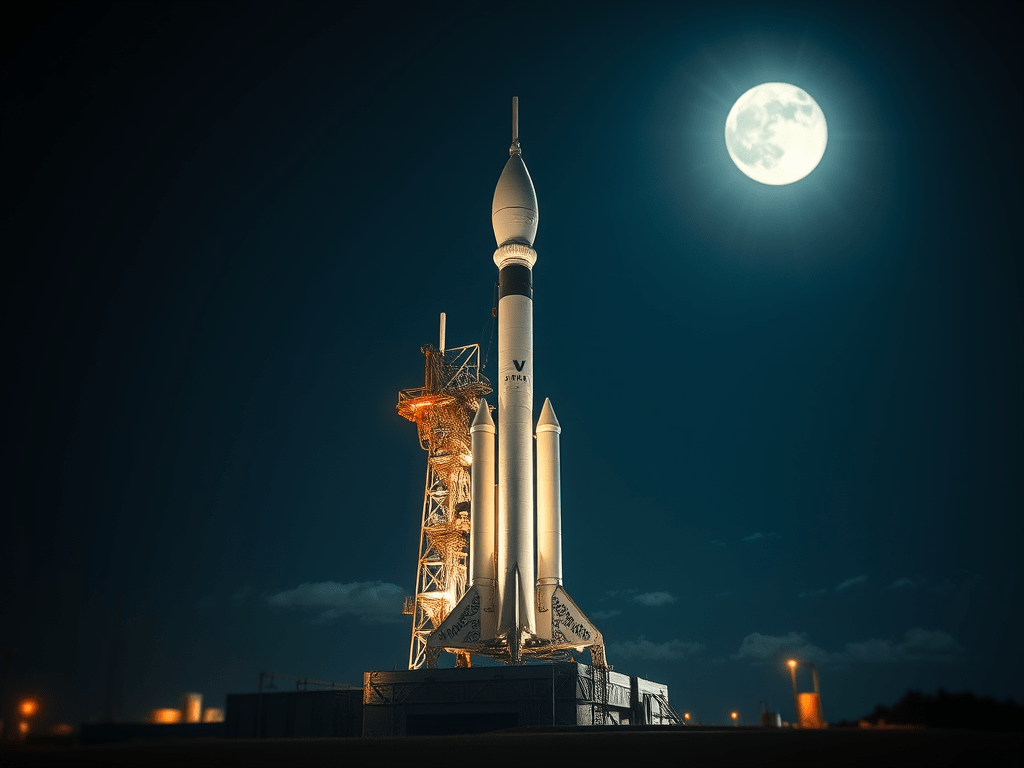
Artemis II: Humans to Circle the Moon for the First Time in Over 50 Years
Nasa announced today, Friday 20 February 2026, that it is targeting 6 March (7 March in the UK) to launch the Artemis II mission, sending humans around the Moon for the first time in more than 50 years. The mission represents humankind’s furthest trip into space and a major milestone in the Artemis program, which is designed to pave the way for future lunar landings and deep-space exploration.
Meet the Artemis II Crew
The Artemis II crew includes three Americans: Reid Wiseman, Victor Glover and Christina Koch, and one Canadian, Jeremy Hansen. The astronauts will live and work inside the Orion capsule, which is roughly the size of a minibus, for the full 10-day mission, performing scientific observations, eating, sleeping and monitoring spacecraft systems.
The Space Launch System (SLS) Rocket
The mission will launch aboard Nasa’s Space Launch System (SLS), a 98-meter (322-foot) tall rocket. The SLS has flown only once before in November 2022 during the uncrewed Artemis I mission. The astronauts will spend the first day in Earth orbit before beginning a four-day journey to the Moon.
The Lunar Flyby and Mission Path
During the flyby, the crew will travel around the far side of the Moon, which is never visible from Earth. They will fly at a distance of 6,500–9,500 km (4,000–6,000 miles) above the lunar surface, dedicating several hours to observing and photographing the Moon. After completing the lunar flyby, the astronauts will spend four days returning to Earth, ending with a splashdown in the Pacific Ocean.
Successful Pre-Launch Tests: Wet Dress Rehearsal
The Artemis II mission followed a successful “wet dress rehearsal”, a critical pre-launch test where the rocket is filled with fuel and taken through the full countdown sequence. A previous rehearsal in early February was cut short due to a hydrogen fuel leak, which has now been resolved.
Apollo Scholars and the Legacy of the Apollo Missions
At Apollo Scholars, our name was inspired by the Apollo missions of the 1960s, which first carried humans to the Moon and sparked curiosity and ambition in generations.

“Just as the Apollo missions inspired an entire generation to reach for the stars, Artemis II demonstrates that human exploration continues to push boundaries. At Apollo Scholars, we aim to inspire the same curiosity and determination in our students, encouraging them to explore, ask questions and reach their own milestones in learning.”
Matt
Founder, Apollo Scholars
The Importance of Artemis II for STEM and Education
The Artemis II mission is an excellent example of STEM in action. Students can learn from the mission about space exploration, mission planning, engineering, teamwork and problem-solving. It highlights how curiosity, preparation and technology allow humans to achieve milestones once thought impossible.

Leave a comment