
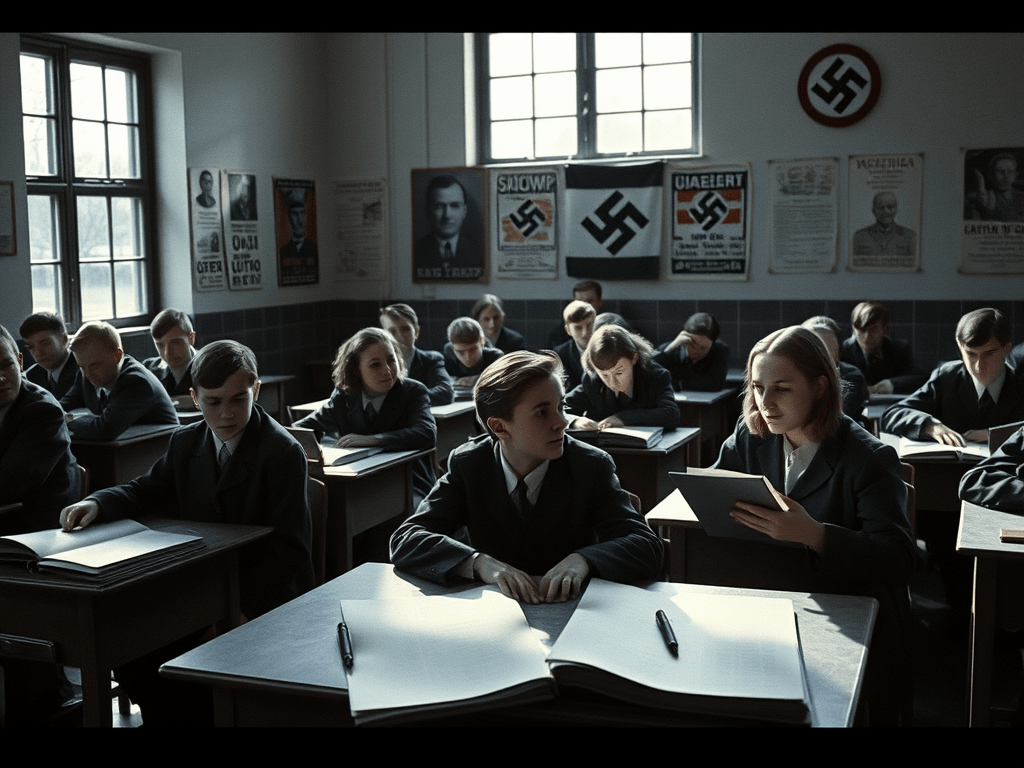
The Nazi regime fundamentally reshaped every aspect of society. Life in Nazi Germany was drastically different from life under the Weimar Republic. Adolf Hitler’s government sought to control daily life in many areas. These included education, the economy, women’s roles and pervasive propaganda. For GCSE and A-level students, it is crucial to understand how Nazi policies affected everyday life. This is important for grasping the full extent of Hitler’s totalitarian regime. This blog will examine the major shifts in daily life under the Third Reich. It will look into how the Nazis imposed their ideology and transformed German society.
Follow us on Instagram, Facebook and LinkedIn.
FAQs About Life Under Nazi Rule
We want to help students better understand the significant changes in Nazi Germany. For this reason, we’ve compiled a set of frequently asked questions (FAQs). These questions cover key aspects of Nazi policies on everyday life. They provide concise explanations to aid GCSE and A-level history studies.
How did Nazi education policies affect students in Germany?
Nazi education policies were designed to indoctrinate students with the regime’s ideology. The curriculum emphasised racial purity, nationalism and loyalty to Hitler. Subjects like History and Biology taught Nazi beliefs about Aryan superiority. Physical education prepared boys for military service. Schools became centers for spreading Nazi ideas.
What role did propaganda play in everyday life under Nazi rule?
Propaganda was a central tool for controlling public opinion in Nazi Germany. The regime used radio, cinema, newspapers and posters to spread messages glorifying Hitler. They also promoted Nazi ideology and incited hatred against Jews and other minorities. Joseph Goebbels was the Minister of Propaganda. He ensured that every aspect of media portrayed the Nazi Party as the saviour of Germany. The influence of propaganda was so pervasive. It shaped public thought, opinion and behaviour in all aspects of daily life.
How did the Nazi economy function?
The Nazi economy focused on reducing unemployment and preparing the country for war. Public works projects like the construction of the Autobahn (highways) created jobs for thousands of Germans. The Reich Labour Service (RAD) also required young men to work on public projects, further reducing unemployment. However, much of the economic recovery happened because of rearmament. Industries focused on producing military equipment in preparation for war. By 1939, the economy was largely militarised.
What was life like for women under Nazi rule?
Women in Nazi Germany were encouraged to leave the workforce and focus on raising children and caring for their families. The Nazi regime promoted traditional gender roles, encapsulated in the slogan “Kinder, Küche, Kirche”(children, kitchen, church). Policies like the Law for the Encouragement of Marriage offered financial incentives for women to marry and have children. The Mother’s Cross rewarded women for having large families. Despite these policies, the war intensified. Many women were needed in the workforce. They filled the gap left by men fighting in the military.
How did Nazi policies impact Jewish people and minorities?
Nazi policies toward Jewish people and other minorities were brutal and discriminatory. Jews faced increasing marginalisation through laws like the Nuremberg Laws of 1935. These laws stripped them of their citizenship. They also prohibited marriages between Jews and non-Jews. Jews were portrayed as enemies of the state through constant anti-Semitic propaganda. This systematic persecution escalated with events like Kristallnacht (the Night of Broken Glass) in 1938. During this event, Jewish properties were destroyed, and thousands of Jews were arrested. This marked a significant shift toward the eventual genocide of six million Jews during the Holocaust.
What was Kristallnacht and why was it important?
Kristallnacht, or the Night of Broken Glass, took place on November 9-10, 1938. It marked a turning point in the Nazi persecution of Jews. During this state-sponsored pogrom, Jewish homes, businesses and synagogues were vandalised and destroyed. Around 30,000 Jewish men were arrested and sent to concentration camps. Kristallnacht is important because it was an escalation of violence against Jews. The aggression moved from discriminatory laws to physical attacks. This shift ultimately led to the Holocaust.
How did the Nazis change the role of women in Germany society?
The Nazis promoted a traditional role for women. They were expected to focus on childbearing and household duties. Supporting their husbands was also a primary expectation. The slogan “Kinder, Küche, Kirche” (children, kitchen, church) encapsulated the regime’s view of women’s roles. Women were encouraged to marry and have many children to increase the Aryan population. The Mother’s Cross rewarded women for having large families. These policies encouraged women to stay at home. However, the outbreak of World War II forced many women to enter the workforce. They had to support the war effort.
What was the Hitler Youth and how did it affect German children?
The Hitler Youth was a Nazi organisation for boys aged 14-18. It was designed to indoctrinate them with Nazi ideology. It also aimed to prepare them for military service. Boys in the Hitler Youth were trained in physical fitness, military drills and loyalty to Hitler. The female counterpart, the League of German Girls, focused on preparing girls for their roles as mothers and homemakers. Participation in these groups became compulsory in 1936. This ensured that all young Germans were exposed to Nazi beliefs from an early age. Their worldview was shaped in line with the regime’s goals.
How did Nazi propaganda influence daily life?
Nazi propaganda was a powerful tool for controlling the thoughts and behaviors of the German population. The regime controlled every form of media, from radio broadcasts to newspapers, films and posters. They ensured that all information promoted Nazi ideals. Joseph Goebbels, the Minister of Propaganda, worked tirelessly. He ensured that Hitler was portrayed as the heroic leader of the nation. Jews and other minorities were depicted as dangerous enemies. The constant bombardment of propaganda in daily life made it difficult for Germans to escape the influence of Nazi ideology.
How did the economy change under Nazi rule?
The Nazi government implemented significant changes to the economy, focusing on job creation and rearmament. Public works projects like the Autobahn created jobs, while industries were reoriented toward military production. The government also introduced conscription and mandatory labour for young men through the Reich Labour Service, further reducing unemployment. However, these economic policies were unsustainable in the long run. They were designed to prepare Germany for war. They did not aim to create a stable economy.
Subscribe to get access
Read more of this content when you subscribe today.


Leave a comment