
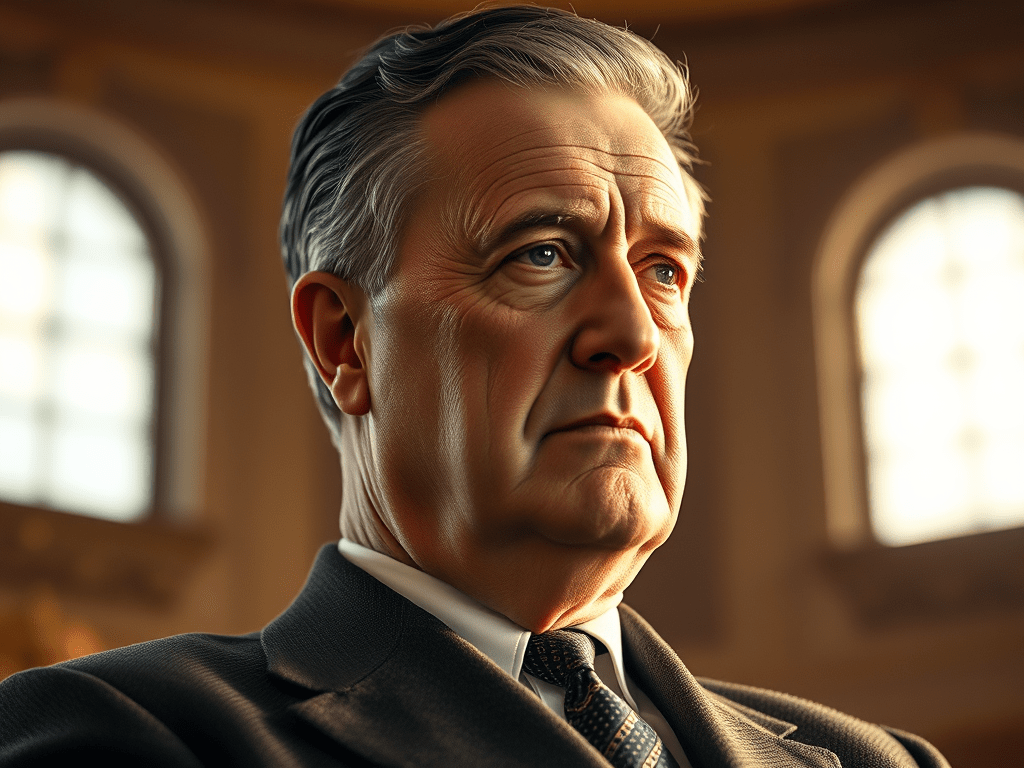
Franklin D. Roosevelt – Early Life and Political Rise
Franklin Delano Roosevelt (1882–1945), often referred to as FDR, was the 32nd President of the United States and the only one to serve four terms in office. His tenure lasted from 4 March 1933 to 12 April 1945. He is remembered as the leader who guided the U.S. through both the Great Depression and most of World War II. Understanding his life and political rise is essential for GCSE and A-level history students, and for anyone wanting a deeper insight into leadership during crisis.
Who Was Franklin D. Roosevelt?
Born into privilege but faced with personal and national challenges, FDR became one of the most influential figures in modern history. His combination of political skill, personal resilience and ability to inspire confidence made him a transformative president.
Early Life and Education
- Born: 30 January 1882, Hyde Park, New York
- Raised in a wealthy family of Dutch ancestry, with strong ties to American political history (he was a distant cousin of President Theodore Roosevelt).
- Attended Groton School in Massachusetts – an elite preparatory school that stressed public service.
- Went on to Harvard University, graduating in history in 1903.
- Began studying law at Columbia University, but left before earning a degree.
From a young age, Roosevelt’s upbringing instilled in him a belief in civic duty and the value of leadership.
Entry into Politics
- FDR entered politics in 1910 as a Democrat, winning a seat in the New York State Senate.
- Served as Assistant Secretary of the Navy (1913–1919) under President Woodrow Wilson, where he gained valuable administrative and military experience during World War I.
- In 1920, ran for Vice President alongside James M. Cox, but lost to Republican Warren G. Harding.
A Life-Changing Challenge – Polio
In 1921, at the age of 39, Roosevelt contracted poliomyelitis, a viral disease that left him permanently paralysed from the waist down. Rather than withdraw from public life, FDR worked tirelessly to continue his political career. He became a symbol of perseverance, using swimming and therapy to maintain his health.
Governor of New York (1929–1932)
- Elected in 1928, Roosevelt brought in innovative social welfare measures to help those hit hardest by the Great Depression.
- Introduced public works projects to create jobs and improve infrastructure.
- His success as governor built his reputation nationally as a leader capable of tackling economic crisis.
The Road to the White House
In the 1932 U.S. presidential election, Roosevelt defeated incumbent Herbert Hoover with a promise of a “New Deal for the American people.” At his inauguration in March 1933, he reassured a nation in crisis with his famous words:
“The only thing we have to fear is fear itself.”
This optimistic and determined approach set the tone for his presidency, which would soon see sweeping reforms and decisive wartime leadership.
Why This Matters for GCSE & A-Level History
For GCSE and A-level history students, Roosevelt’s early life is a case study in:
- The influence of background and education on political leadership.
- The resilience needed to overcome personal adversity.
- The political shifts in the United States during the early 20th century.
When revising this topic, think about how his upbringing, personal challenges and early career shaped the decisions he made as president, especially during the Great Depression.
Further Reading
At Apollo Scholars, we are always on the lookout for works that combine rigorous scholarship with compelling storytelling. That is why we recommend Robert Dallek’s “enthralling” biography of Franklin D. Roosevelt, a richly detailed portrait of one of America’s most influential and consequential presidents. Dallek masterfully weaves political history with personal insight, offering readers both a sweeping narrative and an intimate understanding of Roosevelt’s life and legacy.


Leave a reply to The New Deal and Beyond: Government’s Role in Recovery – Apollo Scholars Cancel reply