
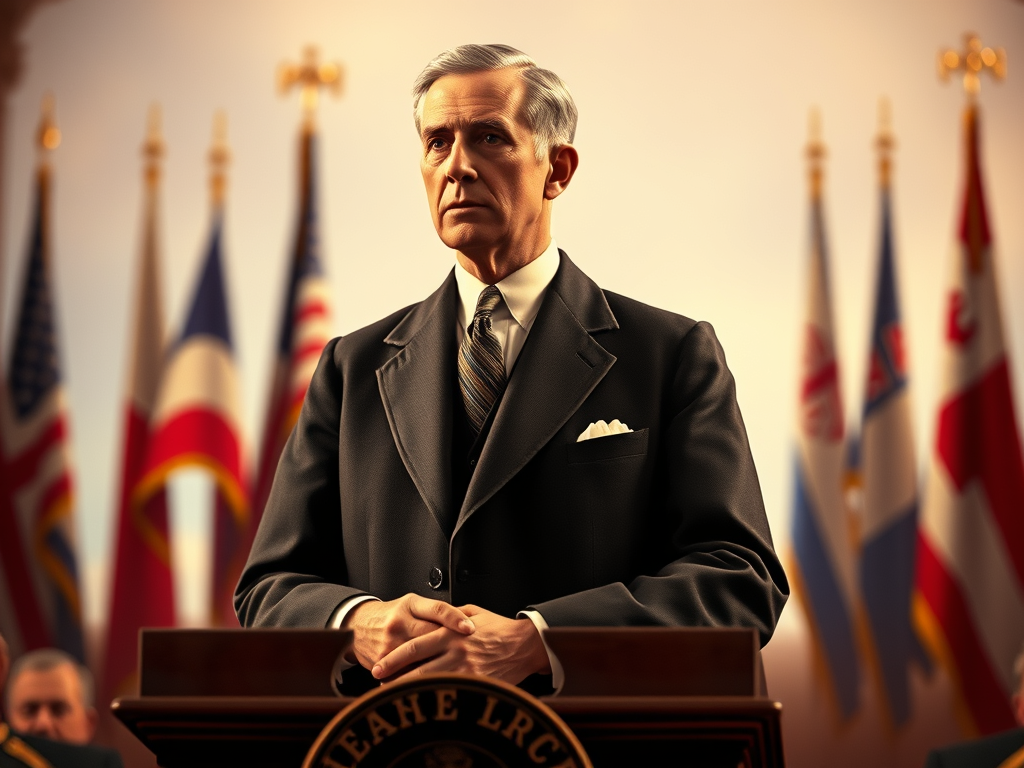
Who Was Woodrow Wilson?
Woodrow Wilson (1856–1924) was the 28th President of the United States, serving from 1913 to 1921. Before entering politics, he was a highly regarded academic, serving as President of Princeton University and a Governor of New Jersey. Known for his intellect, reformist mindset and idealistic vision, Wilson entered the White House at a moment when Europe was on the brink of a conflict that would engulf the world.
Wilson’s presidency is defined by the First World War, American intervention and the postwar peace process. He is remembered as a man of contrasts: a visionary who championed democracy and global cooperation, yet a pragmatist navigating the harsh realities of wartime politics. For GCSE and A-Level history students, Wilson provides a case study in how leadership, diplomacy and ideology intersect, and how individual decisions can shape world events.
The United States and Neutrality: 1914–1916
When World War One broke out in 1914, Wilson declared that the United States would remain neutral. This decision was influenced by several factors:
- American Isolationism: Many Americans believed Europe’s disputes should remain Europe’s problem. The U.S. had a long-standing tradition of avoiding entangling alliances.
- Diverse Population: Millions of German and Irish immigrants resided in the U.S., creating divided loyalties that made support for either side politically risky.
- Economic Considerations: American trade flourished with both the Allies and Central Powers in the early years of the war. Businesses and banks had significant investments at stake.
- Wilson’s Moral Vision: He hoped that the U.S. could act as a neutral mediator, promoting peace and diplomacy rather than conflict.
Despite these factors, neutrality was increasingly difficult to maintain as the war escalated. German actions, unrestricted submarine warfare and violations of American shipping interests gradually pushed the U.S. closer to conflict.
Key Events Leading to U.S. Entry into WW1
German Submarine Warfare
Germany’s use of unrestricted submarine warfare in 1917 was a turning point. Submarines targeted ships trading with Britain, including American vessels. The 1915 sinking of the Lusitania, which resulted in the deaths of 128 Americans, provoked outrage and demonstrated the vulnerability of neutral powers. Germany’s aggressive strategy aimed to weaken Britain, but instead helped draw the U.S. into the conflict.
The Zimmermann Telegram
In January 1917, Britain intercepted a secret German communication to Mexico, known as the Zimmermann Telegram. Germany promised Mexico U.S. territories (Texas, Arizona and New Mexico) in exchange for joining the war against America. Once revealed, the telegram inflamed U.S. public opinion and shifted political support toward intervention. It became a key component in generating support for the American declaration of war on Germany in April 1917.
Economic and Political Ties
By 1917, American banks and businesses were heavily invested in Britain and France. A German victory threatened these investments and the balance of power in Europe. Economic self-interest intertwined with moral reasoning, giving Wilson both practical and ideological reasons to enter the war.
Wilson’s Moral Imperative
Wilson framed U.S. involvement as a mission to “make the world safe for democracy.” This idealistic rhetoric elevated America’s entry beyond strategic calculation, portraying it as a moral obligation to support freedom and international order.
The Fourteen Points: Vision for Peace
In January 1918, Wilson delivered a speech to Congress outlining his Fourteen Points, a plan for a just and lasting peace after WW1. These points were revolutionary in advocating for:
- Open Diplomacy: End secret treaties that had contributed to the war.
- Freedom of the Seas: Ensure safe international navigation.
- Equal Trade Conditions and Disarmament: Reduce competition and arms races.
- Self-Determination: Allow nations, particularly in Eastern Europe, to choose their own governments.
- League of Nations: An international body designed to prevent future wars.
The Fourteen Points reflected Wilson’s idealism, presenting a vision for international cooperation and justice. They also served a strategic purpose: boosting Allied morale and demonstrating American commitment to a fair postwar settlement.
Wilson at the Paris Peace Conference
The Big Three
At the 1919 Paris Peace Conference, Wilson negotiated with Georges Clemenceau (France) and David Lloyd George (Britain), the other major Allied leaders. Their priorities often clashed:
- Wilson: Advocated for fairness, self-determination and the League of Nations.
- Clemenceau: Sought harsh punishment for Germany to secure French security and weaken Germany militarily, strategically and economically.
- Lloyd George: Balanced the public demand for retribution with practical considerations for European stability.
The Treaty of Versailles
The Treaty of Versailles represented a compromise between Wilson’s idealism and the demands of his European allies. Germany faced reparations, territorial losses and military restrictions, but Wilson’s League of Nations concept was included in the treaty. While Wilson achieved part of his vision, the harsh terms imposed on Germany contradicted his principles of fairness, demonstrating the challenges of reconciling ideals with political realities.
Challenges at Home: Why did the U.S. Reject the League of Nations
Ironically, the United States never joined the League of Nations. Wilson faced several obstacles:
- Senate Opposition: Many Senators feared the League would commit the U.S. to future foreign conflicts.
- Isolationist Sentiment: Americans wanted to avoid further European entanglements after the devastation of WW1.
- Wilson’s Health: A stroke in 1919 left him partially incapacitated, preventing him from effectively campaigning for ratification.
The absence of the U.S. weakened the League and contributed to its inability to prevent the global crises of the 1930s.
Wilson’s Legacy: Complexity and Controversy
Wilson’s legacy is complex and multifaceted:
- Strengths: He expanded America’s influence, inspired a vision for peace and decisively led during a global crisis.
- Weaknesses: He misjudged European politics, failed to secure domestic support for the League and faced strong opposition at home.
- Controversies: Domestically, he promoted racial segregation in federal offices, a deeply troubling aspect of his presidency.
Wilson’s life teaches students that leaders operate under immense constraints and that history is shaped not only by intentions but also by circumstance, opposition and the information available at the time.
Lessons for GCSE and A-Level Students
Studying Wilson helps students understand several key exam topics:
- Causes and consequences of U.S. entry into WW1
- The Fourteen Points and their impact on the postwar world
- The Treaty of Versailles and its political compromises
- The challenges and failures of the League of Nations
Wilson’s career demonstrates that history is rarely about simple outcomes. It is about decisions, context and the tensions between ideals and reality, which are central to both GCSE and A-Level assessments.

“Woodrow Wilson reminds us that history is rarely black and white. He envisioned a world governed by justice and cooperation, yet faced enormous constraints at home and abroad. For students, Wilson’s story demonstrates that history is about context, decisions and leadership under pressure. Learning from figures like Wilson helps cultivate perspective, critical thinking and resilience, which are skills essential not only for exams but for life.”
Matt
Founder, Apollo Scholars
Why Woodrow Wilson Matters Today
Wilson’s story is not only historical; it is relevant for understanding modern diplomacy. His ideas about international cooperation, fairness in treaties and global responsibility continue to influence how historians and political scientists view international relations. For students, he is a reminder that individual leaders can shape world events, but their impact is always mediated by circumstance, allies, opponents and domestic politics.
Conclusion
Woodrow Wilson played a pivotal role in WW1, the Fourteen Points and the Treaty of Versailles. He delayed U.S. entry into the war, transformed the conflict once America joined and inspired hope for a fairer postwar world. Yet his inability to secure U.S. support for the League of Nations shows that even bold ideas have limits.
For GCSE and A-Level students, Wilson is a case study in leadership, diplomacy and the complex nature of historical decision-making. His life teaches that history is not only about outcomes but also about the choices, context and principles that shape those outcomes.
Leave a Reply to Why the League of Nations Failed: Key Reasons Explained – Apollo ScholarsCancel reply