
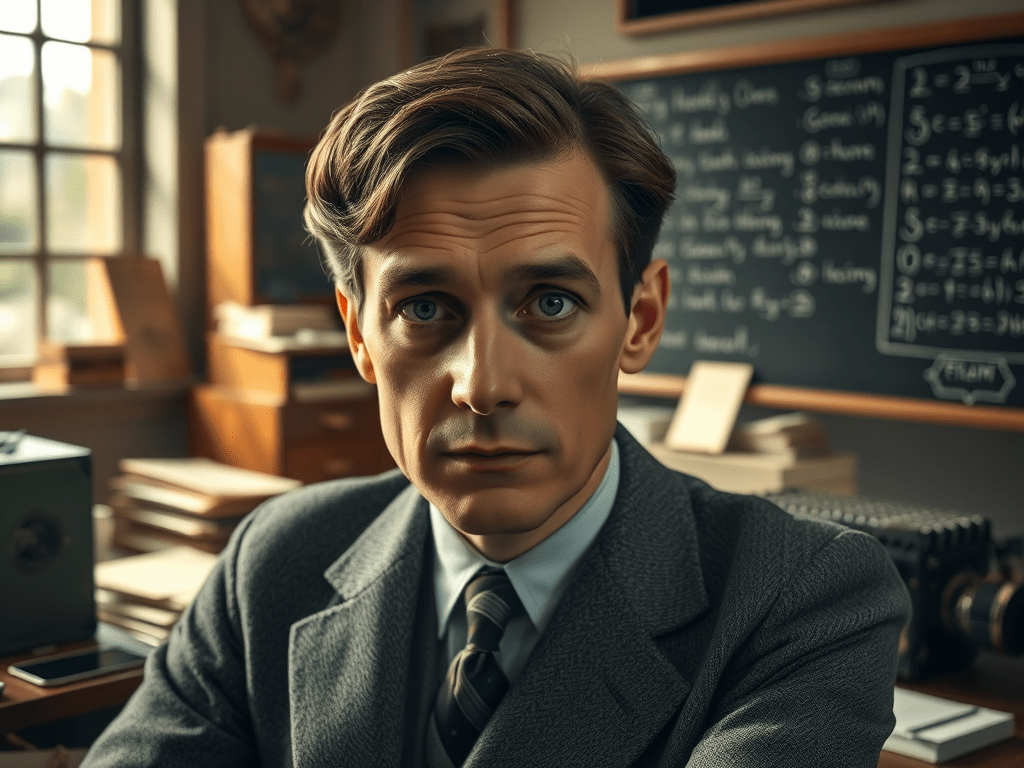
Alan Turing is one of the most important figures of the 20th century. A brilliant mathematician, wartime codebreaker and pioneer of computer science, Turing’s work shaped the outcome of the Second World War and laid the foundations of the digital world we live in today. For GCSE and A-Level history students, Turing’s story is not only about genius and innovation but also about resilience, prejudice and a legacy that still inspires in the 21st century.
Who Was Alan Turing?
Alan Turing (1912–1954) was a British mathematician, logician and cryptanalyst. Educated at Cambridge and Princeton, he showed extraordinary brilliance in abstract mathematics. Yet it was during the Second World War that his genius became most crucial.
At Bletchley Park, Britain’s codebreaking centre, Turing led the efforts to crack the Enigma code used by Nazi Germany to encrypt military communications. His work gave the Allies a decisive advantage, saving countless lives and shortening the war.
What Did Alan Turing Do During World War II?
Cracking the Enigma Code
The Enigma machine was thought to be unbreakable. German forces relied on it to send secure communications. Turing, however, developed an electromechanical device called the Bombe, which dramatically sped up the process of decoding Enigma messages.
This breakthrough meant that Allied commanders could anticipate German attacks, protect shipping convoys from U-boats, and gain vital intelligence throughout the war. Winston Churchill later described Bletchley Park’s work as the single greatest contribution to Allied victory.
Collaboration at Bletchley Park
Turing worked with a team of brilliant men and women, including Gordon Welchman, Joan Clarke and thousands of lesser-known codebreakers. Their secret efforts remained hidden for decades but were vital to Allied success.
Why Is Alan Turing Called the Father of Modern Computing?
Beyond wartime cryptography, Turing’s theoretical work revolutionised the field of computing.
- In 1936, he proposed the concept of the Turing Machine, a thought experiment that described how a machine could follow instructions (algorithms) to solve problems. This idea became the foundation of modern computer science.
- After the war, Turing worked on some of the earliest real computers, such as the Automatic Computing Engine (ACE).
- His ideas underpin the devices we all use today, smartphones, laptops and artificial intelligence systems, making Turing a true pioneer of the digital age.
What Happened to Alan Turing After the War?
Despite his extraordinary contributions, Turing’s life ended in tragedy. In 1952, he was prosecuted for homosexuality, which was then illegal in Britain. He was forced to undergo chemical castration and lost his security clearance.
Turing died in 1954, aged just 41, in circumstances officially recorded as suicide. For decades, his story was overshadowed by secrecy and prejudice.
Only in the 21st century did Britain begin to recognise his contributions and apologise for the injustice he suffered. In 2009, the UK government issued a formal apology, and in 2013 he received a posthumous royal pardon. Today, his face appears on the £50 note, a symbol of how far society has come in recognising his achievements.
Why Does Alan Turing Matter in the 21st Century?
Alan Turing’s legacy continues to shape the modern world in ways GCSE and A-Level students can directly relate to:
- Artificial Intelligence: Turing’s famous “Turing Test” asked whether a machine could convincingly imitate human conversation. This idea still drives debates about AI today, from chatbots to self-driving cars.
- Cybersecurity: Turing’s work on encryption is at the heart of today’s digital world, where protecting data is crucial.
- Equality and Inclusion: Turing’s persecution reminds us of the dangers of discrimination. His story connects history to ongoing struggles for human rights and acceptance.
For students, Turing shows how one person’s ideas can change the world and how society must learn from both triumphs and mistakes.
Lessons from Alan Turing for Students
Alan Turing’s life teaches us:
- Innovation matters: His creative thinking reshaped history.
- Resilience is vital: He worked under immense pressure and secrecy.
- Context shapes history: His genius was recognised too late because of prejudice.
- Legacy lasts: His ideas power the technologies we use daily.

“Alan Turing’s story combines brilliance and tragedy. Like a figure from Shakespeare, he achieved greatness yet suffered injustice. His work cracked the codes that helped win a war, but his ideas also cracked open the future of computing, AI and digital life. For students, Turing shows that history is not just about battles or treaties, but about visionaries who imagine the impossible. His legacy is a reminder that knowledge and courage are the real engines of progress.”
Matt
Founder, Apollo Scholars
Why Students Should Study Alan Turing
For GCSE and A-Level students, Alan Turing represents:
- A bridge between WWII history and modern technology.
- A case study in how individuals can change the course of events.
- A reminder that progress in science and society is shaped by both brilliance and justice.
Turing’s story is not just about the past. It is about the present, from AI debates to equality, and about the future that students themselves will shape.


Leave a reply to Causes of the Second World War Explained for Students – Apollo Scholars Cancel reply