

In 1953, long before satellites, smartphones, or space travel, two men achieved something that seemed impossible. Sir Edmund Hillary, a beekeeper from New Zealand, and Tenzing Norgay, a Sherpa mountaineer from Nepal, became the first confirmed climbers to reach the summit of Mount Everest, the highest point on Earth.
Their triumph was not powered by technology or fame; it was driven by courage, teamwork and a shared belief that no peak is too high to climb.
The Dream That Began with Mallory and Irvine
Nearly thirty years earlier, George Mallory and Andrew “Sandy” Irvine had made a daring attempt on Everest in 1924. They vanished high on the mountain, leaving behind one of history’s greatest mysteries: did they reach the summit before perishing in the thin air?
Their disappearance captivated the world and inspired a new generation of climbers. When Hillary and Tenzing finally stood on the summit in 1953, it was not just their victory; it was the achievement of the dream Mallory and Irvine had died chasing.
Two Paths, One Purpose
Edmund Hillary was born in Auckland, New Zealand, in 1919. Tall, humble and disciplined, he worked as a beekeeper; an occupation that taught him patience and endurance.
Tenzing Norgay, born in the Khumbu region of Nepal, grew up in the shadow of Everest. His life as a Sherpa climber gave him unmatched knowledge of the mountains and an inner strength honed by years of guiding others to safety.
Their worlds could not have been more different, yet fate brought them together on a mission that would unite them forever in history.
The 1953 British Everest Expedition
Led by John Hunt, the 1953 British Mount Everest Expedition was meticulously organised, blending scientific precision with human grit. Hillary and Tenzing were chosen as the final assault pair after weeks of acclimatisation and unsuccessful attempts by other climbers.
They carried primitive gear by today’s standards. Even their tents were made from heavy canvas. Yet, their spirit was unbreakable. As Hillary later put it, “We knocked the bastard off.”
It is astonishing to remember: this achievement came 16 years before humans walked on the moon, with far fewer resources but the same fearless drive to push beyond the known world.
The Final Ascent
On May 29, 1953, after hours of battling icy winds, exhaustion and dangerously thin air, Hillary and Tenzing reached the top of Mount Everest at 11:30 a.m. They stood together, side by side, at the highest point on Earth, 8,848 meters above sea level.
Tenzing planted the flags of Britain, Nepal, India and the United Nations, while Hillary photographed the scene, proof of their shared triumph.
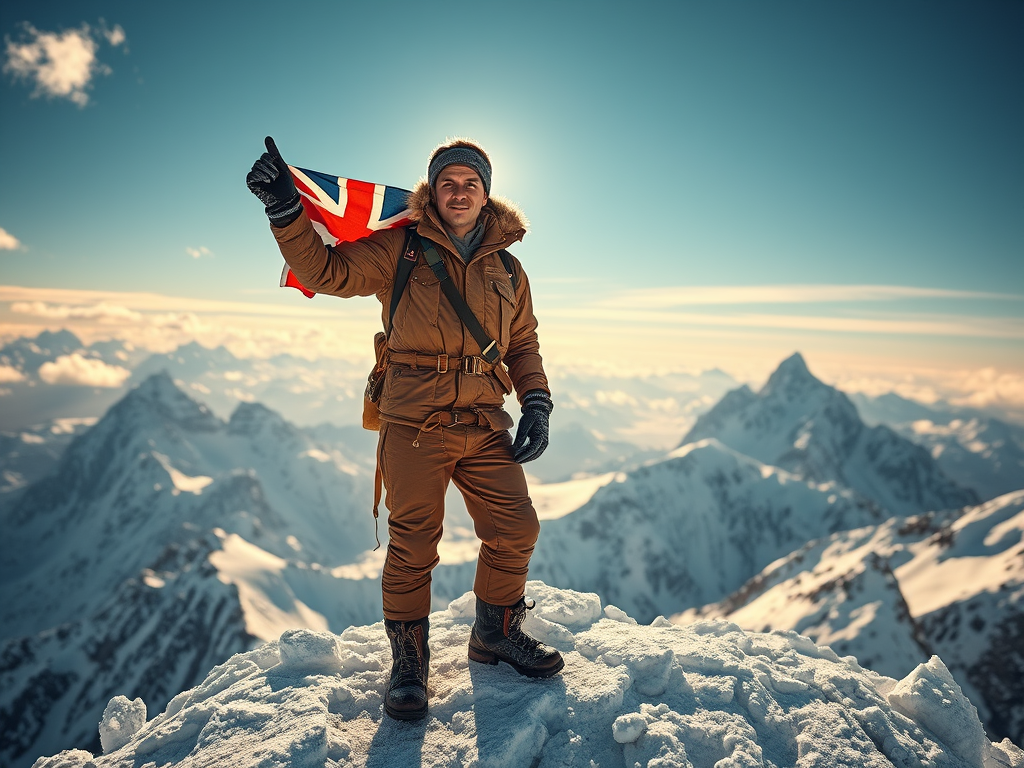
Note: This image was generated using AI and does not depict the actual historical event. It is for illustrative purposes only. For more information on our AI image generation policy, please visit this link.
A Coronation Gift for a New Queen
When word of their success finally reached London days later, transmitted by coded message, it arrived just in time for Queen Elizabeth II’s coronation. Newspapers across Britain proclaimed it a “coronation gift” for the new queen, a symbol of renewal and hope in a post-war world.
Their ascent was not just a mountaineering victory; it was a global moment of pride that united people across nations.
The Legacy They Left Behind
After Everest, both men turned their fame into purpose.
Hillary founded the Himalayan Trust, which built schools, hospitals and airstrips in Nepal, giving back to the Sherpa communities that had helped make his dream possible.
Tenzing Norgay became a national hero in Nepal and India, dedicating his life to inspiring future generations of climbers. Together, they embodied the values of humility, friendship and service that continue to inspire explorers to this day.
At Apollo Scholars, we believe education and exploration share the same spirit, the courage to climb higher, learn deeply and reach beyond what seems possible.

“The 1953 British Everest Expedition has always been one of my favourite adventure stories. It is a tale of courage, teamwork and determination and reminds us that true success is not about standing above others, but about lifting others up along the way. At Apollo Scholars, that is what learning is all about: helping every student find their own summit.”
Matt
Founder, Apollo Scholars
Why Their Story Still Matters
Hillary and Tenzing’s journey is more than a story of climbing a mountain; it is a story of human potential. With little more than wool, willpower and unwavering trust, they did something no one had done before.
For students today, their story reminds us that greatness does not require perfect conditions, only determination, teamwork and belief in something bigger than yourself.
That is the same belief that drives Apollo Scholars: helping students find their strength, face their challenges and discover what they are capable of achieving.
Continue the Journey: Our 5-Part Everest Series
If this story inspired you, do not stop here. We have created a five-part blog series that dives deeper into the legendary 1953 expedition:
- The Dream of Everest – From Mallory to Hillary
How a lost generation’s dream set the stage for history. - The Team Behind the Triumph – Meet the 1953 Expedition
The unsung heroes who made the summit possible. - Strategy, Survival and the Summit
How precision planning and courage won the climb. - The World Reacts – A Coronation Gift and a Global Sensation
How news of the climb spread and inspired the world. - Legacy on the Roof of the World – Hillary, Tenzing, and the Human Spirit
How two climbers became lifelong symbols of hope and humanity.
COMING SOON: Read the full series on Apollo Scholars to explore the people, strategy and spirit behind one of humanity’s greatest achievements.


Leave a reply to The Legacy of Everest: How Hillary and Tenzing Changed the World – Apollo Scholars Cancel reply