
Welcome Back to Our World Space Week Series!
All this week, Apollo Scholars is celebrating World Space Week 2025, exploring how space inspires innovation, discovery and learning.
So far, we have journeyed through the history of exploration, imagined life in space and discovered how technology built for space benefits life on Earth.
Today, we are looking ahead to the future of space. What comes next? Who will go there? And how could you be part of it?
Back to the Moon: The Artemis Era
The next giant leap is already underway.
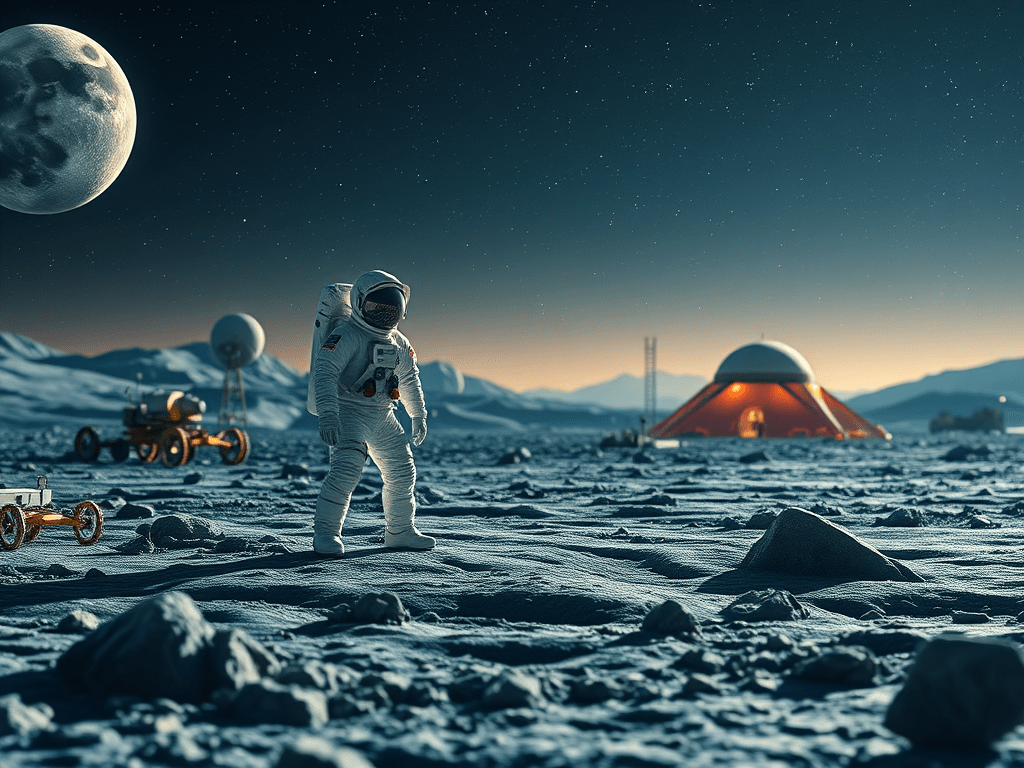
NASA’s Artemis Programme is sending astronauts back to the Moon for the first time since the Apollo missions of the 1960s, the very missions that inspired our name at Apollo Scholars.
However, Artemis is not just about repeating the past. This time, astronauts plan to stay, building the first sustainable lunar base and preparing for the next great journey: Mars.
Scientists are already designing:
- Lunar habitats built from Moon rock (regolith).
- Robotic rovers that scout resources like water ice.
- Communication networks that connect the Moon and Earth in real time.
For students learning STEM, these projects show the power of human curiosity and teamwork, proof that maths, science and engineering can take humanity beyond what once seemed possible.
Destination Mars: Humanity’s Next Frontier
Mars has always captured our imagination, and now it is within reach.
NASA, the European Space Agency and private companies like SpaceX are preparing missions that could put humans on Mars in the next two decades.
Living on Mars will require solving extraordinary challenges:
- Creating oxygen and fuel from the Martian atmosphere.
- Growing food in low gravity and freezing temperatures.
- Protecting habitats from radiation and dust storms.
These are exactly the kind of problems today’s students could help solve tomorrow, through studying biology, chemistry, robotics and environmental science.

“When Neil Armstrong walked on the Moon, the average age of the engineers who made it happen was just 27. That means the students learning STEM today could be the ones designing the rockets, habitats and technologies that take us to Mars.”
Matt
Founder, Apollo Scholars
Beyond Mars: Asteroids, Exoplanets and Deep Space
The future of exploration does not stop at Mars. Scientists are dreaming even bigger:
- Asteroid mining could one day provide metals and minerals for both Earth and space industries.
- Space telescopes are helping us search for exoplanets, worlds that might resemble Earth.
- Deep space missions, like Voyager and New Horizons, continue to send data from billions of kilometres away.
Every new mission expands our understanding of what is possible and reminds us that exploration is not just about where we go, but what we learn along the way.
Space Tourism: The Dawn of a New Industry
Space is not just for astronauts anymore. Companies like Blue Origin, Virgin Galactic and SpaceX are developing spacecraft that will take paying passengers to the edge of space.
While it is currently expensive, these early steps could pave the way for future generations to experience space travel as easily as we take flights today.
With that comes the need for engineers, technicians, safety experts and scientists, all careers rooted in STEM education.
The Role of STEM in the Future of Space
Every step toward the stars begins in a classroom with a question, an experiment and a bit of imagination.
At Apollo Scholars, we believe the next era of exploration will be shaped by students like you, curious minds who dream big and learn how to turn ideas into innovation.
“Exploring space is not just about leaving Earth, it is about pushing boundaries, asking questions and building the skills to solve problems no one has ever faced before.”
Matt
Founder, Apollo Scholars
STEM is not just a subject; it is a launchpad for discovery.
Student Challenge: Imagine the Next Mission
Your task for today:
- Imagine you are leading a mission to Mars or beyond.
- Give your mission a name.
- Describe its purpose and one problem it aims to solve.
Share your ideas with us on social media using #WorldSpaceWeek and #ApolloScholars. We would love to see your creativity in action!
Final Thought: The Future Starts Now
The next great leap for humanity will not happen decades from now; it is already beginning.
Every test tube in a science lab, every equation solved in maths class and every idea shared between students brings us one step closer to the stars.
So keep learning, stay curious and never stop looking up.


Leave a reply to How Space Exploration Improves Life on Earth – Apollo Scholars Cancel reply