
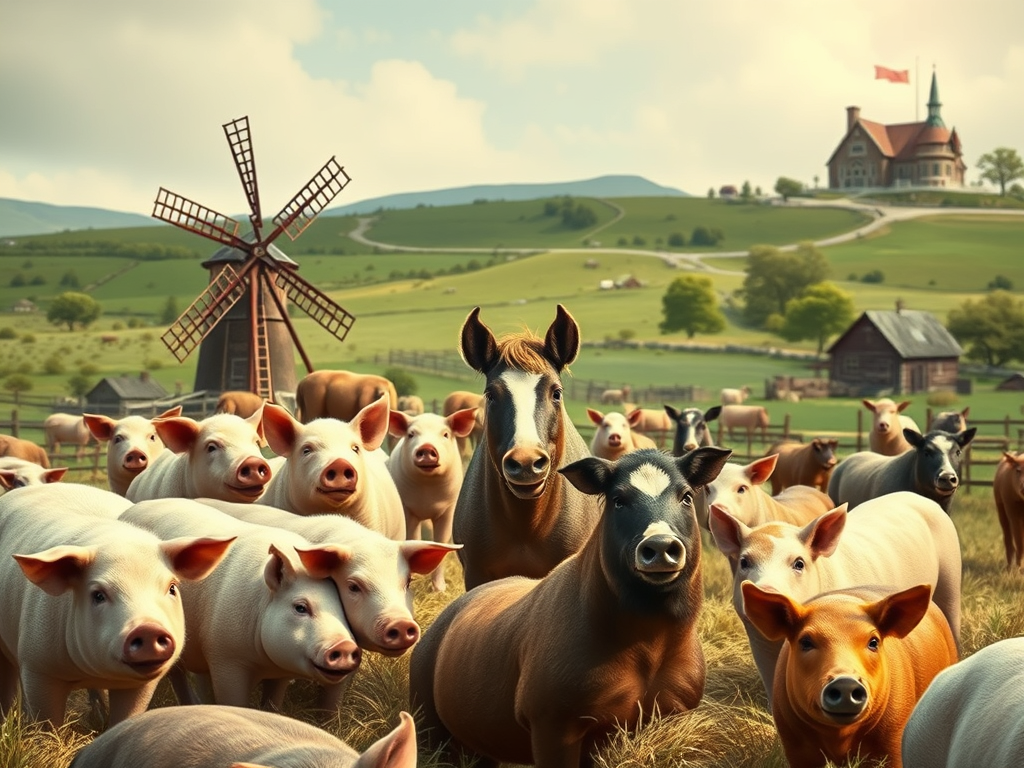
Start with the Apollo Scholars Animal Farm GCSE Revision Guide
Before diving into this comprehensive study hub, make sure you have the Apollo Scholars Exclusive Animal FarmGCSE Revision Guide.
It helps students:
- 📘 Understand chapter-by-chapter summaries and detailed analysis
- 💬 Explore Orwell’s key themes, symbols and character development
- ✍️ Access model paragraphs, essay structures and sample answers
- 🧠 Prepare for exam questions with structured guidance
👉 Download the Apollo Scholars Exclusive Animal Farm Revision Guide to master the novel and secure top GCSE grades.
Who Was George Orwell and Why Did He Write Animal Farm?
George Orwell, born Eric Arthur Blair in 1903, was a political writer and journalist.
- Orwell was deeply concerned with totalitarian regimes, propaganda and social injustice.
- Animal Farm, published in 1945, is a political allegory of the Russian Revolution and Stalinist USSR.
- He used animals on a farm to show how revolutionary ideals can be corrupted by power.
GCSE Insight: Understanding Orwell’s background helps students link historical context to his allegory, a key analytical skill.
What Are the Major Themes in Animal Farm?
| Theme | Explanation & Examples |
|---|---|
| Power and Corruption | The pigs’ rise to power shows how absolute power corrupts absolutely. |
| Betrayal of Ideals | The revolution’s original principles are abandoned by those in power. |
| Propaganda and Manipulation | Squealer and other leaders manipulate language to control the animals. |
| Class and Inequality | The pigs live in luxury while other animals toil, showing social stratification. |
| Loyalty and Blind Obedience | Boxer’s trust and hard work highlight the dangers of unquestioning loyalty. |
| Disillusionment and Loss | The dream of Animalism is replaced with tyranny, demonstrating moral decay. |
Students should note how Orwell combines storytelling and political critique to convey complex ideas.
What Is the Historical Context of Animal Farm?
- Russian Revolution (1917): Overthrow of the Tsar, rise of Bolsheviks.
- Stalin’s Regime: Showed totalitarian control, propaganda and purges, reflected in Napoleon and the executions.
- World War II Aftermath: Orwell wrote the novel as a cautionary tale about ideological betrayal.
- Understanding this context is crucial for GCSE essays.
How Does Orwell Use Allegory and Symbolism?
- Animals as People:
- Pigs → Bolsheviks/Stalinist leaders
- Boxer → Working class
- Mr. Jones → Tsarist regime
- Symbols and Motifs:
- The Windmill → Industrialisation and broken promises
- Beasts of England → Revolutionary slogans and hope
- Students can link allegory to theme, context and historical comparison for essay answers.
How Does Animal Farm Explore Leadership and Morality?
- Orwell shows different leadership styles through Napoleon, Snowball and the other animals.
- The novel warns that unchecked ambition and lack of moral accountability lead to oppression.
- GCSE Tip: Discuss leadership in essays using quotations and historical parallels.
How Can Students Use This Study Hub Effectively?
- Review chapter summaries and note key plot points.
- Analyse themes, symbolism and character development.
- Make connections between Orwell’s allegory and historical events.
- Practice essay responses using model paragraphs and sample questions.
- Use the revision guide to consolidate understanding and improve exam confidence.

“Animal Farm is more than a story about animals; it is a guide to understanding power, politics and human nature. For GCSE students, seeing how Orwell’s vision, themes and context intersect is key to writing insightful essays. The novel teaches lessons about loyalty, morality and the dangers of blind obedience and with our revision guide, students can explore these lessons in a structured, exam-ready way.”
Matt
Founder, Apollo Scholars
What Happens After Reading the Study Hub?
Once students complete this hub:
- They will understand Orwell’s vision and how it relates to each chapter.
- They can confidently link themes, symbolism and context in essays.
- They are fully prepared to tackle GCSE English Literature questions with a strong analytical approach.
All Blogs in the Animal Farm GCSE Study Series
Animal Farm Chapter 1: The Dream of Rebellion
Animal Farm Chapter 2: The Rebellion Begins
Animal Farm Chapter 3: Equality, Work and Leadership
Animal Farm Chapter 4: Revolution Spreads and War Comes to the Farm
Animal Farm Chapter 5: Power, Propaganda and the Rise of Napoleon
Animal Farm Chapter 6: Hard Work, Broken Promises and Corruption
Animal Farm Chapter 7: Betrayal and Terror on Animal Farm
Animal Farm Chapter 8: Corruption, Hypocrisy and Control
Animal Farm Chapter 9: Death, Deception and Disillusionment
Animal Farm Chapter 10: The Pigs Become Men – The End of the Dream
✅ Animal Farm GCSE Study Hub: Orwell’s Vision, Themes and Context (You Are Here)


Leave a reply to Animal Farm Chapter 5 Summary and Analysis: Power, Propaganda and the Rise of Napoleon – Apollo Scholars Cancel reply