
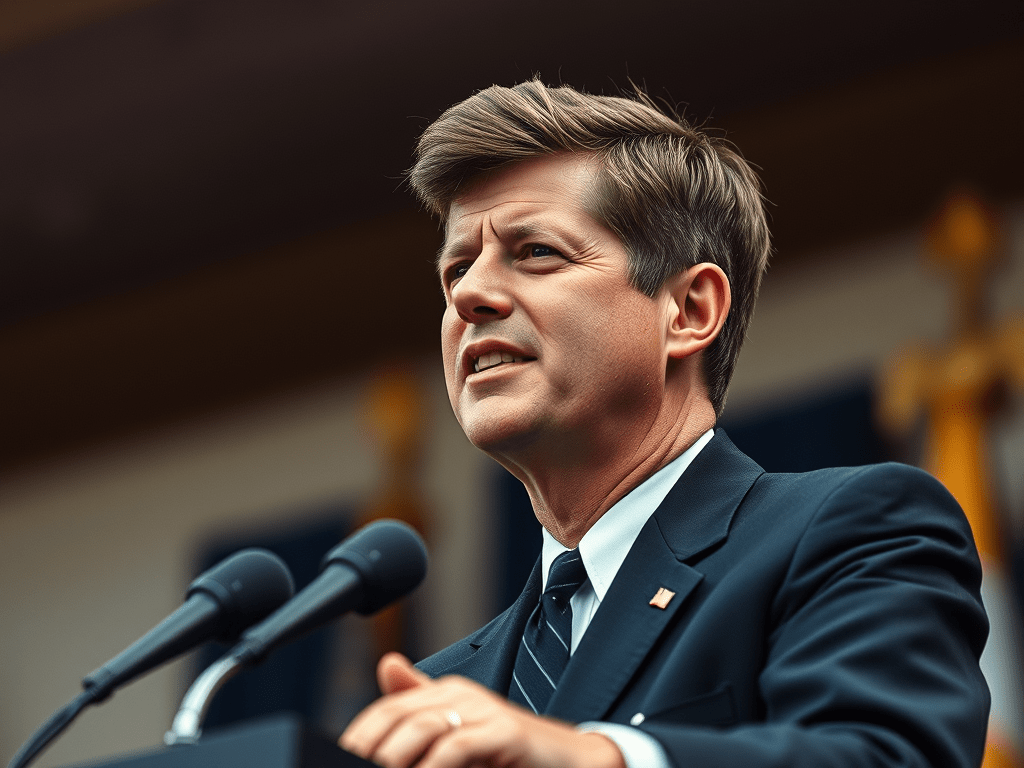
On 22 November 1963, U.S. President John F. Kennedy was assassinated in Dallas, Texas.
The tragedy sent shockwaves around the world, not just because a president was killed, but because a generation lost its sense of hope in a single, shattering moment.
At Apollo Scholars, we covered the facts last year. This year, our focus is on how JFK’s death reshaped America and the world.
Who Was John F. Kennedy and Why Was He Significant?
John F. Kennedy became the 35th President of the United States in 1961, serving at the height of the Cold War. He was only 43 years old, the youngest elected president at the time, and represented a new era of youthful optimism.
His presidency focused on:
- Civil rights: Advocating for equality and laying groundwork for the Civil Rights Act.
- Foreign policy: Managing Cold War tensions, including the Cuban Missile Crisis.
- Science and space: Committing the nation to landing a man on the Moon.
Kennedy inspired the nation with speeches, urging Americans to serve their country: “Ask not what your country can do for you – ask what you can do for your country.”
For students, studying Kennedy’s presidency shows how leadership, policy and communication can influence politics and culture, skills we encourage in tuition and study support.
What Happened on 22 November 1963?
Kennedy was riding in an open-top motorcade through Dealey Plaza, Dallas, accompanied by First Lady Jacqueline Kennedy, Texas Governor John Connally and Nellie Connally.
At 12:30 p.m., three shots rang out. Kennedy was struck twice. The fatal bullet hitting his head. Within half an hour, he was pronounced dead at Parkland Memorial Hospital, and Vice President Lyndon B. Johnson was sworn in as President aboard Air Force One.
Where Did JFK’s Assassination Take Place?
The shooting occurred in Dealey Plaza, near the Texas School Book Depository.
Today, the plaza is home to The Sixth Floor Museum, which explores Kennedy’s life, the assassination and its global impact. Students can explore the museum virtually or in person to connect historical events with broader societal changes.
Why Was JFK Shot?
The question of why Kennedy was shot remains one of the biggest unanswered questions of the 20th century, alongside:
- Who truly killed him, and why?
- Who benefited most from his death?
Many theories exist: political opposition, Cold War tensions, organised crime and personal motives. Kennedy’s leadership during high-stakes events like the Cuban Missile Crisis made him both admired and controversial.
For students, these unresolved questions highlight the importance of critical thinking, analysis and evaluating multiple perspectivess.
Who Killed JFK?
Lee Harvey Oswald, a former U.S. Marine and Soviet defector, was arrested shortly after the assassination. Two days later, Jack Ruby shot Oswald live on television, shocking the nation.
The Warren Commission concluded that Oswald acted alone, yet debate persists. This case gives students a real-world example of how evidence is interpreted differently, teaching skills essential for exam preparation, essay writing and academic reasoning.
How Did JFK’s Assassination Affect America?
The assassination marked a turning point in public trust, politics and media:
- Politics: America entered a more sceptical era, facing the Vietnam War, civil rights struggles and political scandals.
- Media: The assassination was one of the first events broadcast globally, creating a shared experience that changed journalism.
- Culture: It left a lasting impact on music, literature and public consciousness, influencing generations of students and citizens alike.
How Did JFK’s Death Impact His Family?
The assassination profoundly affected the Kennedy family. His brother, Bobby Kennedy, later pursued a career in politics, carrying forward his vision of justice and public service. Learn more about Bobby Kennedy here.
The assassination also intersected with high-profile figures such as Jimmy Hoffa, whose influence on 1960s America is explored in this article. Linking these events gives students a broader understanding of political, social and criminal contexts.
How Did the Cold War Influence JFK’s Presidency and Death?
Kennedy’s presidency occurred during the height of the Cold War, when tensions between the US and Soviet Union were extremely high. His foreign policy decisions, including the Cuban Missile Crisis and Berlin negotiations, placed him at the fulcrum of global attention.
Some historians suggest that international political tensions may have indirectly influenced the assassination, demonstrating for students the intersection of global events and individual leadership decisions.
Why Do Conspiracy Theories About JFK Persist?
Despite official investigations, questions remain about:
- Oswald’s motives
- Potential accomplices
- Who benefited from Kennedy’s death
For students, this provides an opportunity to analyse sources critically, explore historical debate and understand why multiple perspectives exist in history.
What Lessons Can Students Learn from 22 November 1963?
Studying the Kennedy assassination teaches students:
- Leadership and legacy: Understanding how JFK’s actions influenced politics, society and media.
- Critical thinking: Evaluating multiple sources, theories and perspectives.
- Media literacy: Learning how news coverage shapes public perception.
- Historical perspective: Seeing how singular events can influence culture, policy and global consciousness.

“When the shots were heard around the world that day in Dallas, they did not just end a presidency; they began a new era. Kennedy’s influence reached far beyond his lifetime, shaping everything from the struggle for civil rights to the course of the Vietnam War. His words still remind us that leadership is not about how long one serves, but how deeply one’s vision continues to move the world forward.”
Matt,
Founder, Apollo Scholars
Key Facts About the Kennedy Assassination
- Date: November 22, 1963
- Location: Dealey Plaza, Dallas, Texas
- President: John F. Kennedy (35th U.S. President)
- Assassin: Lee Harvey Oswald (alleged)
- Successor: Lyndon B. Johnson
- Legacy: Transformation of media, political trust and American identity
Conclusion: Remembering 22 November 1963
More than sixty years later, the Kennedy assassination still stands as one of the most defining, and haunting, moments of the twentieth century. It was not only the loss of a leader but the loss of an era’s optimism, captured forever in those few seconds in Dallas.
His presidency may have been brief, but its impact continues to ripple through history; in the movements he inspired, the ideals he championed and the questions that remain unanswered.
As we reflect this year, it is worth revisiting our On This Day feature from last November, where we explored the events of 22 November 1963, and the immediate aftermath. This year’s reflection turns the page; from the tragedy itself to the enduring influence it left on politics, media and the human spirit.
Kennedy’s story reminds us that history is never static. It evolves, reshaped by memory, meaning and time, and in that evolution, we continue to find new lessons worth learning.


Leave a reply to On this day: John F. Kennedy’s Assassination in 1963 – Apollo Scholars Cancel reply