
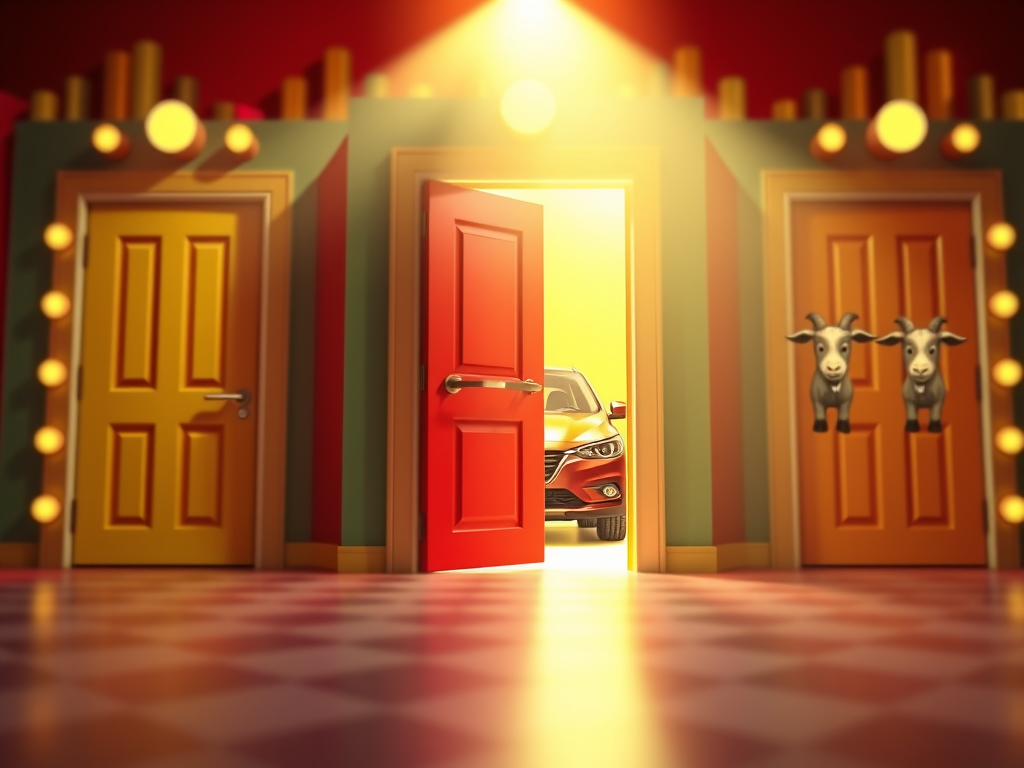
Imagine this: you are on a game show. In front of you are three doors.
Behind one door is a car.
Behind the other two are goats.
You pick a door.
The host, who knows where the car is, opens one of the other two doors and reveals… a goat.
Now there are two doors left:
- Your original choice
- The other unopened door
The host asks: Do you want to switch?
Be honest: your brain probably says, “It is 50/50. It does not matter.”
That is exactly why the Monty Hall Problem is famous.
Because that answer is wrong.
And once you see why, you will never forget it.
The Shocking Claim: You Should Always Switch
Here is the headline result:
If you switch doors, you win the car 2 times out of 3.
If you stay, you only win 1 time out of 3.
So switching doubles your chances.
Let’s break that down slowly and simply.
Step 1: What Are Your Chances at the Start?
At the beginning, when you pick one door out of three:
- Chance your door has the car: 1/3
- Chance the car is behind one of the other two doors: 2/3
Nothing controversial so far.
Step 2: The Host Does Something Very Important
The host always:
- Knows where the car is
- Opens a door with a goat
- Never opens the door with the car
- Never opens your chosen door
This is crucial. The host is not choosing randomly.
So when the host opens a goat door, they are giving you information.
Step 3: Where Does the 2/3 Probability Go?
Your original door still has a 1/3 chance of being right.
That has not changed.
The other two doors together had a 2/3 chance of hiding the car.
However, now one of those doors is gone (and it was definitely a goat).
So that entire 2/3 probability gets concentrated onto the one remaining unopened door.
So now:
- Your original door: 1/3
- The other unopened door: 2/3
Which would you rather have?
Exactly. Switch.
Step 4: A Super Simple Way to See It
Let’s imagine you play this game 100 times.
- About 33 times, you originally pick the car → switching makes you lose.
- About 67 times, you originally pick a goat → the host removes the other goat → switching makes you win.
So:
- Stay = win about 33 times
- Switch = win about 67 times
Switching wins twice as often.
Step 5: “But It Feels Like 50/50!”
That is the trap.
It looks like two doors = equal chances.
However, the host’s action is not neutral. It is guided by knowledge. That is what keeps the probabilities uneven.
A great way to make this obvious is to imagine 100 doors instead of 3:
- You pick 1 door (1/100 chance it is right)
- The host opens 98 goat doors
- You are left with:
- Your door (still 1/100)
- One other door (now 99/100)
Would you switch?
Of course you would.
The 3-door version is the same idea, just sneakier.
Why This Problem Matters (Beyond Just a Puzzle)
The Monty Hall problem teaches you:
- Probability is about information, not just counting options
- Human intuition is bad at judging uncertainty
- Maths can be surprising, even when it is simple
- Always ask: “What changed, and what stayed the same?”
It is a perfect example of why thinking carefully beats guessing.
The One-Sentence Answer for Exams
You should switch, because your original choice has a 1/3 chance of being correct, while the remaining door has a 2/3 chance after the host removes a goat.
Final Takeaway
Your brain says: “It is 50/50.”
Maths says: “Switch and double your chances.”
And in this case… maths wins every time.
Enjoy the car! You are welcome!


Leave a reply to Understanding Probability with Spinners: A Problem Explained – Apollo Scholars Cancel reply