
Welcome to Apollo Scholars’ World Space Week Series!
This week (4–10 October), Apollo Scholars is celebrating World Space Week 2025 with a special daily blog series exploring the past, present and future of space exploration.
Every day, we will share a new post packed with inspiring stories, space science insights and fun challenges for students. From how we might live on Mars to why exploring space helps life on Earth, each article connects the wonder of the cosmos with the power of learning.
Fittingly, our name, Apollo Scholars, is inspired by the Apollo missions of the 1960s, a time when humanity’s courage and curiosity took us all the way to the Moon.
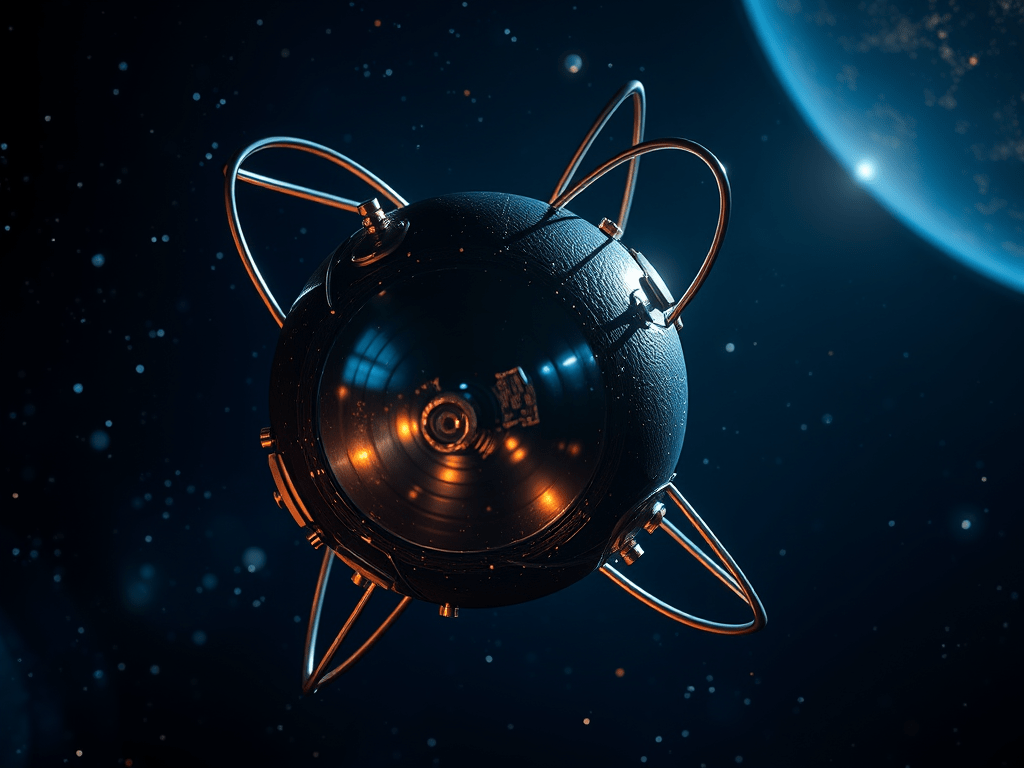
Today, we are starting with the moment that made it all possible, a tiny satellite called Sputnik 1.
The Launch That Changed Everything: Sputnik 1 (4 October 1957)
On 4 October 1957, a small silver satellite named Sputnik 1 was launched into orbit. It did not carry people or fancy cameras, just a radio transmitter that sent a simple “beep… beep… beep…” back to Earth.
However, that sound echoed across the world and changed history.
For the first time, humanity had left the planet. We had proven that Earth was not our limit; it was just the beginning.
Sputnik’s launch inspired a generation of scientists, engineers and dreamers. It marked the start of the Space Age, an era of exploration that continues to shape every part of modern life, from GPS and weather satellites to medical technology and global communication.
Fun fact: Sputnik 1 orbited Earth every 96 minutes. That is over 1,400 laps around our planet before it burned up in the atmosphere!
The Outer Space Treaty: Keeping the Cosmos Peaceful
Fast forward ten years to 10 October 1967, when world leaders signed the Outer Space Treaty. This was an agreement that made space a place of peace, not conflict.
It declared that:
🌍 No country can claim ownership of the Moon or any planet.
🤝 Space must be explored for the benefit of all humankind.
🧑🚀 Astronauts are regarded as “envoys of mankind.”
This treaty reminds us that space belongs to everyone; a shared frontier where collaboration matters more than competition.
Just like good teamwork in school, progress in space happens when nations and people work together.
The Apollo Missions: Turning Imagination Into Reality
The Apollo missions of the 1960s were the next great leap. Powered by courage, creativity and countless hours of learning, they took humanity to the Moon.
When Neil Armstrong stepped onto lunar soil in 1969 and said, “That’s one small step for man, one giant leap for mankind,” the world held its breath. It was not just a triumph of engineering; it was proof of what human curiosity and education can achieve.
The Apollo era taught us:
🔬 Science helps us understand where we are in the universe.
⚙️ Technology pushes the boundaries of what is possible.
📏 Maths and physics make space travel safe and precise.
💡 Teamwork and learning make exploration meaningful.
That is why we called ourselves Apollo Scholars, because every student has the potential to think boldly, question deeply and make discoveries that shape the future.
Interesting fact: When Neil Armstrong walked on the Moon, the average age of the team behind him, the scientists, engineers and problem-solvers at NASA, was only 27 years old.
Why Space Exploration Still Matters
Some people ask: “Why spend money exploring space when we have problems here on Earth?” The answer is simple. Space exploration helps us solve them.
🌦️ Weather and climate satellites help us track storms, predict droughts and understand climate change.
🩺 Medical advances from space research improve healthcare on Earth (like heart monitors and robotic surgery).
📡 Satellite communication connects our world, from classrooms to hospitals.
🔋 Engineering breakthroughs from space missions lead to cleaner energy and smarter technology.
Exploring space is not about leaving Earth behind; it is about learning how to take better care of it.
Perhaps most importantly, space exploration gives us hope. It reminds us that no dream is too big and no challenge too hard when we work together, stay curious and keep learning.

“The Apollo missions showed us what is possible when knowledge, courage and teamwork come together to bend the arc of history. When Neil Armstrong walked on the Moon, it was not just a moment in history; it was proof of what learning can achieve. STEM education gives young people the power to solve problems, to explore and to build the future, whether that is in a lab, a classroom, or one day, among the stars.”
Matt
Founder, Apollo Scholars
Student Challenge: Become a Space Scholar
🚀 Challenge of the Day:
Research one Apollo mission and find a modern technology that came from it, like memory foam, solar panels, or freeze-dried food. Then ask yourself: How could space exploration help make life better in the future?
Share your ideas with us on social media using #WorldSpaceWeek and #ApolloScholars. We would love to feature student ideas in our wrap-up post on 10 October!
Final Thought: The Sky Is Not the Limit
Space exploration began with a single “beep” from Sputnik, and it has not stopped since.
This week, as we celebrate World Space Week 2025, remember: you do not have to be an astronaut to explore. Every question you ask, every equation you solve, every idea you test – it is all part of the same human adventure.
When it comes to learning and discovery, the sky is never the limit.
Stay tuned. Our next blog explores what it really means to “live in space” and how scientists are preparing humans to build homes among the stars.


Leave a reply to Technology and Innovation: Making Life in Space Possible – Apollo Scholars Cancel reply