
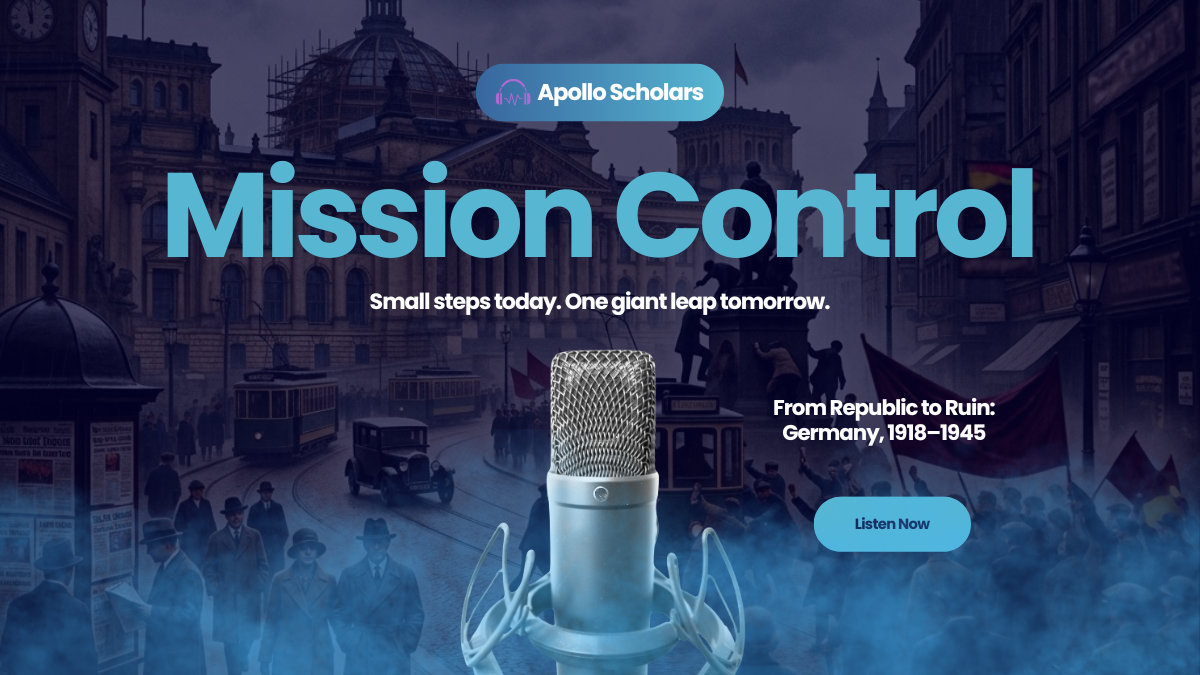
The first full episode of Mission Control is here.
After introducing Mission Control, the brand-new educational podcast from Apollo Scholars, we are now ready to get into our first subject.
Our first full episode explores one of the most important questions in modern history:
How did Hitler rise to power?
From the aftermath of the First World War and the creation of the Weimar Republic to economic crisis, political instability and the growing popularity of extremist politics, Hitler’s rise to power was shaped by a complicated combination of circumstances and decisions.
In this episode, Matt and Lucy begin to unpack that story and explore how Adolf Hitler and the Nazi Party went from the political fringes to the centre of German politics.
Welcome to Mission Control
Mission Control has been created to make academic subjects easier to understand.
Each episode will take a topic from the world of History, Economics, Business, English Literature or English Language and explore the ideas, events and questions behind it.
The aim is not simply to give you more information.
It is about helping you understand the bigger picture – why things happened, why they mattered and how different factors connect.
That is particularly important when studying a topic such as Nazi Germany.
There are dates to remember, people to know, political developments to understand and a huge amount of historical detail to work through. However, beneath all of that are much bigger questions about democracy, political instability, economic crisis, leadership and the choices made by individuals and governments.
That is where our first episode begins.
Our First Topic: Hitler’s Rise to Power
Nazi Germany is one of the most widely studied topics in twentieth-century history, appearing across History courses as well as wider discussions of modern European history.
However, knowing what happened is not always the same as understanding why it happened.
How could a democracy that had existed for more than a decade be dismantled so rapidly?
Why did support for the Nazi Party increase?
How important was the economic crisis of the early 1930s?
What role did Hitler himself play?
These are some of the questions at the heart of our first episode.
Rather than attempting to cover every aspect of Nazi Germany, this episode focuses on the beginning of the story: the circumstances that created an opportunity for Hitler and the Nazi Party to gain increasing political influence.
From the Weimar Republic to Hitler
Understanding Hitler’s rise to power means going back before Hitler became Chancellor in January 1933.
Germany’s defeat in the First World War, the establishment of the Weimar Republic and the political challenges that followed all provide important context.
The new democratic government faced opposition from across the political spectrum, while Germany experienced periods of serious economic and political instability.
The situation became even more difficult following the Wall Street Crash and the onset of the Great Depression.
As unemployment increased and confidence in established political parties declined, support for more radical alternatives grew.
The Nazis were able to take advantage of this changing political environment.
However, that does not mean their rise was inevitable.
The episode explores some of the different factors that helped create the conditions for the rise of the Nazi Party and considers the decisions and circumstances that ultimately brought Hitler to the centre of political power in Germany.
Why did Hitler become Chancellor?
One of the most fascinating parts of Hitler’s rise to power is that he did not simply win an election and become dictator.
His appointment as Chancellor was the result of a much more complicated political process.
It involved elections, political negotiations, opposition to the Weimar Republic and decisions made by Germany’s political leaders.
Once Hitler became Chancellor, however, the situation changed rapidly.
The Nazis began transforming the political system and removing the institutions and opposition that could challenge their authority.
For students studying Nazi Germany, understanding this process is crucial.
It is also one of the reasons we have chosen it as the first major topic for Mission Control.
A New Way to Explore What You Are Studying
Mission Control is not intended to replace your lessons, textbooks or revision materials.
Instead, we want it to be another way of engaging with the subjects you are studying.
Sometimes hearing an explanation can help you understand something that did not quite click when you first encountered it in a textbook. Sometimes a podcast can help you revise while travelling, walking or simply taking a break from your desk.
And sometimes you might just want to explore a topic because it is interesting.
That is why we have developed and launched Mission Control.
Whether you are preparing for an upcoming exam, working on an essay, revising a difficult topic or simply curious about the world around you, we hope the podcast gives you another way to learn.
Listen to The First Episode
Mission Control: Hitler’s Rise to Power is available now.
Join Matt and Lucy as they begin exploring the story of Nazi Germany and the circumstances behind Hitler’s rise to power.
This is only the beginning.
Future episodes will take us across History, Economics, Business, English Literature and English Language, exploring the ideas and questions that sit behind the subjects you study.
🎧 Listen to Mission Control on Spotify and follow the podcast so you do not miss the next episode.
Studying Democracy and Nazism: Germany, 1918–1945?
You can also explore our exclusive Apollo Scholars revision guide, Democracy and Nazism: Germany, 1918–1945.
Designed to support students studying this important period of German history, the guide provides a dedicated resource to use alongside your lessons, revision and now the Mission Control podcast.
Find out more about Apollo Scholars and our one-to-one and small-group online tuition at www.apolloscholars.co.uk.
Welcome to Mission Control. Let’s get into it.
Leave a Reply