
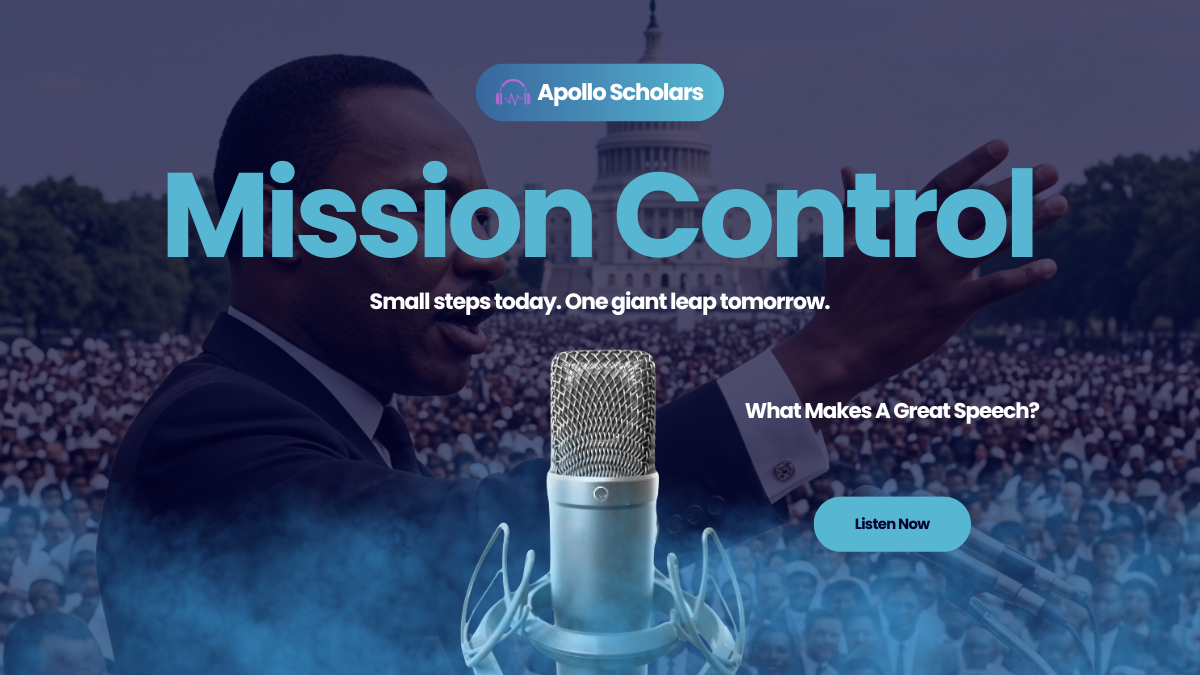
What makes a great speech is one of the most practical questions in the whole of English Language. It is exactly where we are headed in Episode 005 of Mission Control.
Every day, people try to persuade one another: politicians make their case, teachers explain complex ideas and students argue their points in assessments. Behind every speech that truly connects, however, sits a deliberate combination of choices about structure, language and delivery.
First, a speaker needs to give their ideas a clear shape; then, they need to choose language that suits their audience and purpose; finally, they need to deliver those ideas with confidence and control.
Yet, when these elements fail to work together, even a strong argument can quickly lose its impact. Some speeches ramble without a clear direction, others rely on language that does not suit the moment and many simply disappear from the audience’s memory within an hour.
In this latest episode from Apollo Scholars, Matt and Lucy pull apart four speeches that have lasted for decades, to work out what they actually have in common, and what any student can borrow from them.
After exploring markets and market failure in Episode 004, we are turning to a completely different subject: English Language.
What actually separates a forgettable speech from an unforgettable one? Why do techniques like repetition and contrast work on an audience in the first place? Can the tools behind Churchill’s wartime broadcasts or Malala Yousafzai’s UN address really help with a student’s speech-writing task?
That is the story we are exploring in Episode 005.
AI Disclosure: This episode has been created with the assistance of advanced AI tools as part of the Apollo Scholars content production process. All content has been reviewed and edited for accuracy.
Welcome to Mission Control
Mission Control is the educational podcast from Apollo Scholars, exploring the ideas, events and stories behind the subjects you study.
Across the series, we explore History, Economics, Business, English Literature and English Language, breaking down complicated topics and making them easier to understand, remember and connect together.
Mission Control is not just about revision.
Whether you are studying for an exam, preparing to write a speech of your own, or simply curious about why some speeches are still quoted decades later, each episode is designed to tell a story first.
After all, English Language is not just about memorising a list of techniques.
It is about understanding why they work.
What Makes a Great Speech?
For our fifth full episode, we are tackling one of the most practical skills in English Language: how to write, and how to recognise, a genuinely great speech.
Every speech, from a wartime broadcast to a school assessment, is really just an attempt to move an audience through structure and language. Get it right, and a handful of sentences can be remembered for generations. Get it wrong, and even a good argument falls flat.
We have divided the story into six chapters, taking you from the very first question of what a speech is trying to do, through four contrasting case studies, to what any student can actually borrow for their own writing.
1. What Makes a Speech Unforgettable?
Before looking at individual speakers, this chapter sets up the idea that great speeches are not accidents. They are built from an identifiable toolkit of choices around structure, language and audience. That toolkit can be learned, spotted and reused.
2. Repetition and Rhythm: Martin Luther King’s “I Have a Dream”
This chapter looks at how King builds momentum through anaphora, repeating a phrase at the start of successive sentences. He pairs it with vivid imagery that turns an abstract idea like equality into something an audience can actually picture.
3. Balance and the Rule of Three: JFK’s Inaugural Address
Here we explore antithesis, balancing two contrasting ideas within a single sentence, and the tricolon, grouping ideas in threes, both used to give a formal, controlled speech its memorable shape.
4. Short Sentences, Big Impact: Churchill in Wartime
This chapter examines how a long, building list of promises followed by a short, blunt final line can hit far harder than the short line alone. We also explore why honesty about a difficult situation can be part of what makes a speaker trusted in the first place.
5. The Power of Restraint: Malala Yousafzai at the UN
Not every powerful speech relies on elaborate technique. This chapter looks at how plain, direct language and direct address can carry enormous weight when the speaker’s own story is doing most of the work.
6. Building Your Own Great Speech
The final chapter draws the four case studies together into a practical framework: structure, deliberate technique, audience connection and register, that any student can apply to their own speech-writing tasks.
Can Anyone Learn to Write a Great Speech?
One of the biggest questions raised by this episode is not simply which techniques a great speech uses, but whether those techniques can really be taught at all.
Is a powerful speech really just a matter of natural talent, or can structure and language choices be learned and applied deliberately?
Should every speech aim for King’s emotional intensity, or does the right approach depend entirely on the audience and the occasion?
When does plain, restrained language do more work than an elaborate rhetorical flourish?
The answer is more complicated than any single technique suggests. Repetition, antithesis, sentence length and direct address are all genuine, learnable tools. However, using them well depends on matching them to the right audience and register, and overusing any one of them can undo its own effect.
That is one of the central questions we explore in this episode.
Listen to Mission Control Episode 005
Great speeches sit behind some of the most memorable moments of the last century, from civil rights marches to wartime broadcasts to a sixteen-year-old addressing the United Nations.
This episode explores what these speeches actually have in common, and what any student can take from them into their own writing.
Listen to Mission Control: What Makes a Great Speech?
Whether you are studying English Language, preparing for a speech-writing task, or simply curious about why certain lines have lasted for decades, we hope this episode gives you a clearer picture of the bigger story.
Studying English Language?
If you want more personalised support, Apollo Scholars offers 1:1 and small-group tuition across History, Economics, Business, English and Maths.
Book a tuition session with Apollo Scholars.
Welcome Back to Mission Control
English Language can feel like a subject of technique lists to memorise for an exam.
However, once you stop treating rhetorical devices as boxes to tick and start seeing them as deliberate choices made by a real speaker under real pressure, the bigger picture begins to emerge.
From King’s rhythm, through Kennedy’s balance and Churchill’s brevity, to Malala’s restraint, and what any student can borrow from all four.
Six chapters. One story.
Welcome back to Mission Control. Let’s get into it.
Share This Episode
Did you enjoy Episode 005? Share the episode with someone who might enjoy exploring the art of the speech.
Subscribe to Mission Control
New weekly episodes of Mission Control explore the stories, ideas and events behind the subjects you study.
More From Apollo Scholars
Explore our latest educational resources, revision guides, articles and podcast episodes across History, Economics, Business, English and Maths. Visit our Store for exclusive resources.
Leave a Reply