
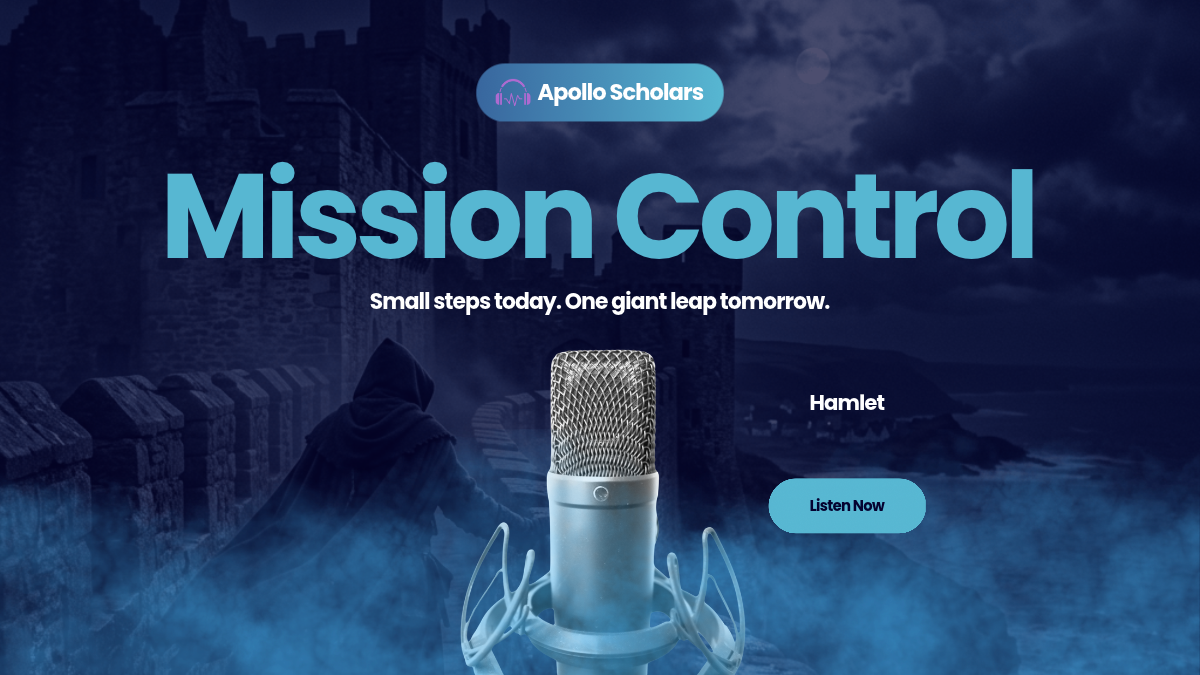
Hamlet analysis is at the heart of Episode 009 of Mission Control, where we explore Shakespeare’s themes, characters and techniques to help students develop deeper insights into this classic text.
Shakespeare’s longest play has been performed, studied and argued over for more than 400 years. Behind every strong essay on Hamlet, however, sits a deliberate combination of choices about quotations, characters, language and context.
First, a student needs to understand what the play is really asking. Next, they need to choose short quotations they can analyse closely. Finally, they need to weigh up different readings and reach a judgement of their own.
Yet when those skills do not work together, even a well-revised essay can lose its impact. Some answers retell the plot without analysis, others drop in quotations without explaining them and many present one reading as if it were the only one.
In this latest episode from Apollo Scholars, Matt and Lucy build the whole conversation around the play’s key quotations. They explore how the language works and what it reveals about character and theme. They also challenge obvious interpretations. The format helps you understand and remember key ideas.
After exploring the Making of Modern Britain in Episode 008, we are turning back to English Literature and one of Shakespeare’s greatest tragedies.
Why does a prince with every reason to take revenge keep putting it off? Is Hamlet really mad, or only pretending? And who is to blame for the tragedy at Elsinore: the ghost, the king, or Hamlet himself?
That is the story we are exploring in Episode 009.
AI Disclosure: This episode has been created with the assistance of advanced AI tools as part of the Apollo Scholars content production process. All content has been reviewed and edited for accuracy.
Welcome to Mission Control
Mission Control is the educational podcast from Apollo Scholars, exploring the ideas, events and stories behind the subjects you study.
Across the series, we explore History, Economics, Business, English Literature and English Language, breaking down complicated topics and making them easier to understand, remember and connect together.
Mission Control is not just about revision. Whether you are studying for an exam, writing an essay on Hamlet, or simply curious about why this play still feels so gripping, each episode is designed to tell a story first.
After all, English Literature is not just about memorising quotations.
It is about understanding why they matter.
What Is Hamlet Really About?
For our ninth full episode, we are tackling one of the most studied plays in the English language: Shakespeare’s Hamlet.
At its heart, the play follows a man who is told to take revenge, and who cannot bring himself to act. Get the analysis right, and a single line of a soliloquy can unlock a whole scene. Get it wrong, and even a good memory of the plot will not carry an essay.
We have divided the story into six chapters, taking you from the world the play was written in, through its characters and big questions, to the language, structure and essay tips that help you write about it with confidence.
Where Does Hamlet Come From? Context and Revenge Tragedy
Before exploring individual scenes, it is worth understanding the world in which Hamlet was written. Composed around 1600, towards the end of Elizabeth I’s reign, the play draws on the popular genre of revenge tragedy and reflects contemporary debates about private revenge, Protestant beliefs about ghosts and anxieties over the divine right of kings and royal succession. Understanding this context means going beyond simply listing historical facts. It means explaining how these ideas shaped Shakespeare’s choices and influenced the play’s meaning.
A Ghost, a Plan and a Duel: The Story at Speed
This chapter follows the plot from the ghost’s revelation and Hamlet’s antic disposition, through The Mousetrap and the killing of Polonius, to Ophelia’s madness and the final fencing match. We pick out the moments that matter most, and the lines that carry them, such as “the time is out of joint” and “the play’s the thing.”
Why Does Hamlet Delay? Conscience, Proof and Over-Thinking
Here we explore the play’s biggest question. We test the main explanations against the text: conscience, the need for proof, grief, political danger and self-torment. We look closely at “To be or not to be” and the idea that “the native hue of resolution is sicklied o’er with the pale cast of thought,” and we weigh up how foils like Laertes and Fortinbras sharpen the picture.
Hamlet, Claudius, Gertrude and Ophelia: The Characters in Their Own Words
This chapter explores how Shakespeare uses language to develop his characters. We begin with Hamlet and consider whether he fits the role of a tragic hero. Next, we examine Claudius, a villain troubled by guilt, and Gertrude, whose character is largely shaped by Hamlet’s judgement. We then turn to Ophelia and consider whether she is a victim, an agent of her own choices, or both. Finally, we explore the roles of Polonius and Horatio.
Seems, Rot and Skulls: Themes in Hamlet
Here we explore the ideas that run through the play, from appearance and reality, to corruption and decay in “something is rotten in the state of Denmark,” to death and mortality in the graveyard scene with Yorick’s skull. We also look at madness, real and feigned and at whether revenge can ever restore justice.
Writing About Hamlet: Language, Structure and Evaluation
The final chapter brings everything together in a practical framework for analysing Hamlet. We explore soliloquies, metatheatre, imagery, wordplay and Shakespeare’s use of verse and prose. We also examine how the ending works. Finally, we consider how to build a clear argument, analyse short quotations effectively and evaluate different interpretations.
Is Hamlet a Hero, a Victim or the Architect of His Own Downfall?
One of the biggest questions raised by this episode is not simply what happens in Hamlet, but why it happens at all.
Is Hamlet’s delay a flaw, or a sign of a thoughtful conscience?
Is Claudius simply a villain, or a more complicated figure than he first appears?
Does the ending restore order, or does it show how much has been lost?
The answer is more complicated than any single reading suggests. Hamlet has several good reasons to hesitate, but he also lets chances slip. Claudius is guilty of murder, yet he is clever, capable and visibly tormented. The play offers evidence for more than one interpretation. The strongest essays tend to explore those tensions rather than choosing one side.
That is one of the central questions we explore in this episode.
Listen to Mission Control Episode 009
Few plays capture the gap between thinking and acting as vividly as Hamlet, from a prince who calls the world “an unweeded garden” to a final scene that ends with the words “the rest is silence.”
This episode explores how Shakespeare builds that journey, from the way a short quotation can carry a whole idea, to what any student can take from it into their own writing.
Whether you are studying English Literature for an exam, revising for a mock, or simply curious about why this play has lasted for centuries, we hope this episode gives you a clearer picture of the bigger story.
Are You Studying English Literature?
If you want more personalised support, Apollo Scholars offers personalised 1:1 online support and online group tuition across History, Economics, Business, English and Maths. Whether you need help with essay technique, close analysis or revision, our online tutoring is built around your goals and your level.
You can also visit our Store for exclusive resources to support your revision.
Welcome Back to Mission Control
English Literature can feel like a subject of quotations to memorise for an exam.
However, once you stop treating quotes as facts to learn and start seeing them as deliberate choices made by a playwright shaping an audience’s response, the bigger picture begins to emerge.
From a ghost on the battlements, through doubt, performance and madness, to a stage full of bodies.
Six chapters. One story.
Welcome back to Mission Control. Let’s get into it.
Share This Episode
Did you enjoy Episode 009? Share it with someone who might enjoy exploring Shakespeare’s most famous tragedy.
Subscribe to Mission Control
New weekly episodes of Mission Control explore the stories, ideas and events behind the subjects you study.
More From Apollo Scholars
Explore our latest educational resources, revision guides, articles and podcast episodes across History, Economics, Business, English and Maths. Visit our Store for exclusive resources.
Leave a Reply