
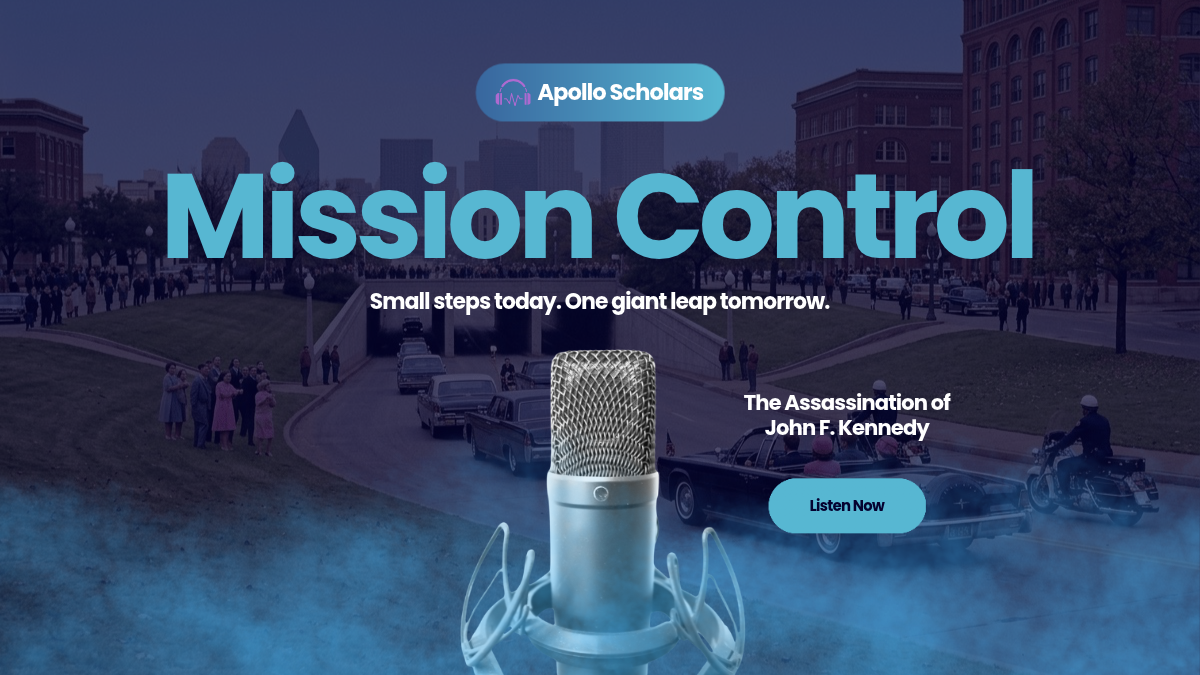
The JFK assassination is the focus of Episode 013 of Mission Control, where we explore who John F. Kennedy was, what happened in Dallas on 22 November 1963 and why six seconds in Dealey Plaza changed America and the Cold War.
From the waters of the Pacific to the brink of nuclear war over Cuba, from the Berlin Wall to the race for the Moon, Kennedy led the United States through the most dangerous years of the Cold War. Then, at 12:30 on a sunny Friday lunchtime, it all ended in an open-top car on Elm Street.
In this latest episode from Apollo Scholars, Matt and Lucy tell the story of the President, the motorcade and the people at the heart of that weekend, including Lee Harvey Oswald, Officer J.D. Tippit, Jack Ruby, Jackie Kennedy and Lyndon B. Johnson. They separate what has been proven from what has been claimed, and show you how to think about one of history’s most debated events like a historian.
After exploring what makes a great story in Episode 012, we are turning to History and one of the most dramatic true stories of the twentieth century.
Who was John F. Kennedy? What really happened in Dallas? And why does the debate about who was responsible still refuse to go away?
That is the story we are exploring in Episode 013.
AI Disclosure: This episode has been created with the assistance of advanced AI tools as part of the Apollo Scholars content production process. All content has been reviewed and edited for accuracy.
Welcome to Mission Control
Mission Control is the educational podcast from Apollo Scholars, exploring the ideas, events and stories behind the subjects you study.
Each episode breaks down complicated topics and makes them easier to understand, remember and connect together. It is not just about revision. It is about understanding ideas rather than simply memorising them.
After all, good history is not about remembering dates. It is about understanding why events happened, what they changed and how we know.
The JFK Assassination: What You Need To Know
For our thirteenth episode, we ask a question that has fascinated people for generations: how did one shocking afternoon in Texas reshape American politics and the Cold War?
At its heart, understanding the JFK assassination means looking at the man, the moment and the aftermath. Get it right, and you can explain the event, its causes and its consequences with confidence. Get it wrong, and it turns into a tangle of rumours and theories with no evidence to hold them together.
We have divided the conversation into six chapters, taking you from Kennedy’s early life through the Cold War crises of his presidency, the events in Dallas and the people involved, to the investigations, the conspiracy theories and his lasting legacy.
1. Who Was John F. Kennedy?
We begin with the man himself. This chapter explores Kennedy’s wealthy Irish Catholic family, his war-hero story aboard PT-109, his hidden health problems and his rise through Congress and the Senate. It also looks at the first televised presidential debate against Richard Nixon and how Kennedy became the youngest person ever elected president.
2. Kennedy And The Cold War
Here we explore the world Kennedy was running. We look at the Bay of Pigs disaster, the Vienna summit with Khrushchev, the Berlin Wall and Ich bin ein Berliner, and the 13 days of the Cuban Missile Crisis. We also cover the hotline, the Partial Test Ban Treaty, the space race, Vietnam and civil rights.
3. Dallas, 22 November 1963
This chapter walks you through the day itself. Why Kennedy went to Texas, the route of the motorcade, the open-top car, the shots in Dealey Plaza, the race to Parkland Memorial Hospital and the moment Walter Cronkite told the nation. We also explain why the Zapruder film became the most studied piece of film ever made.
4. The Key Characters: Oswald, Tippit, Ruby And Johnson
Who was Lee Harvey Oswald, the former Marine who had lived in the Soviet Union? We explore the killing of Officer J.D. Tippit, Oswald’s arrest, Lyndon B. Johnson being sworn in aboard Air Force One, and Jack Ruby allegedly shooting Oswald on live television two days later. We also explain why historians use the word allegedly, and why the lack of a trial still matters.
5. Investigations And Conspiracy Theories
What did the Warren Commission conclude, and what is the single bullet theory? We look at the 1979 House Select Committee on Assassinations, the disputed acoustic evidence, the release of government files and why so many people doubt the official story. Then we share a simple way to test any theory against the evidence.
6. Impact, Consequences And Legacy
The final chapter asks what actually changed. We explore Soviet fears of being blamed, Johnson’s message of continuity, the Civil Rights Act and Voting Rights Act, the escalation of the Vietnam War, the Moon landing in 1969, new rules on presidential protection and the 25th Amendment, and how the myth of Camelot shaped Kennedy’s legacy.
Did Oswald Act Alone?
One of the biggest questions raised by this episode is not simply what happened in Dallas, but who was responsible and how we can know.
Could one man with a cheap rifle really change the course of history?
Why did two official investigations reach different conclusions?
And would Kennedy have taken America into Vietnam the way Johnson did?
The answer is more interesting than it first appears. Oswald was never tried, so his guilt was never proven in court, and real failures by the intelligence agencies gave people good reasons to ask questions. However, asking questions is not the same as proving a theory. The strongest historical arguments weigh the evidence, consider who is making a claim and why, and are precise about what is known and what is not.
That is one of the central ideas we explore in this episode.
Listen To Mission Control Episode 013
Few events show how quickly history can change direction. From the Cuban Missile Crisis to the Moon landing, from civil rights to Vietnam, this episode explores the JFK assassination and the shadow it cast over the decade that followed.
Whether you are studying the Cold War, working on an essay about modern American history, preparing for an exam or simply fascinated by one of history’s great mysteries, we hope this episode gives you a clearer picture of what happened and why it still matters.
Listen to Mission Control Episode 013: The Assassination of John F. Kennedy
Are You Studying History?
If you want more personalised support, Apollo Scholars offers personalised 1:1 online support and small online group tuition across English, History, Economics, Business and Maths. Whether you need help with the Cold War, source analysis, essay structure or turning evidence into confident arguments, our online tutoring is built around your goals and your level.
Book an online 1:1 or small group session today.
You can also visit our Store for exclusive resources to support your revision.
Welcome Back To Mission Control
The JFK assassination can feel like a maze of names, times and theories.
However, once you start asking who, what and why, the bigger picture begins to emerge.
From a young president at the height of the Cold War, through six seconds in Dallas, to a legacy that still shapes America today.
Six chapters. One question: how did the death of one man change the world?
Welcome back to Mission Control. Let’s get into it.
Share This Episode
Did you enjoy Episode 013? Share it with someone who enjoys history or is studying the Cold War.
Subscribe To Mission Control
New weekly episodes of Mission Control explore the stories, ideas and events behind the subjects you study.
More From Apollo Scholars
Explore our latest educational resources, revision guides, articles and podcast episodes across English, History, Economics, Business and Maths. Visit our Store for exclusive resources.
Leave a Reply