
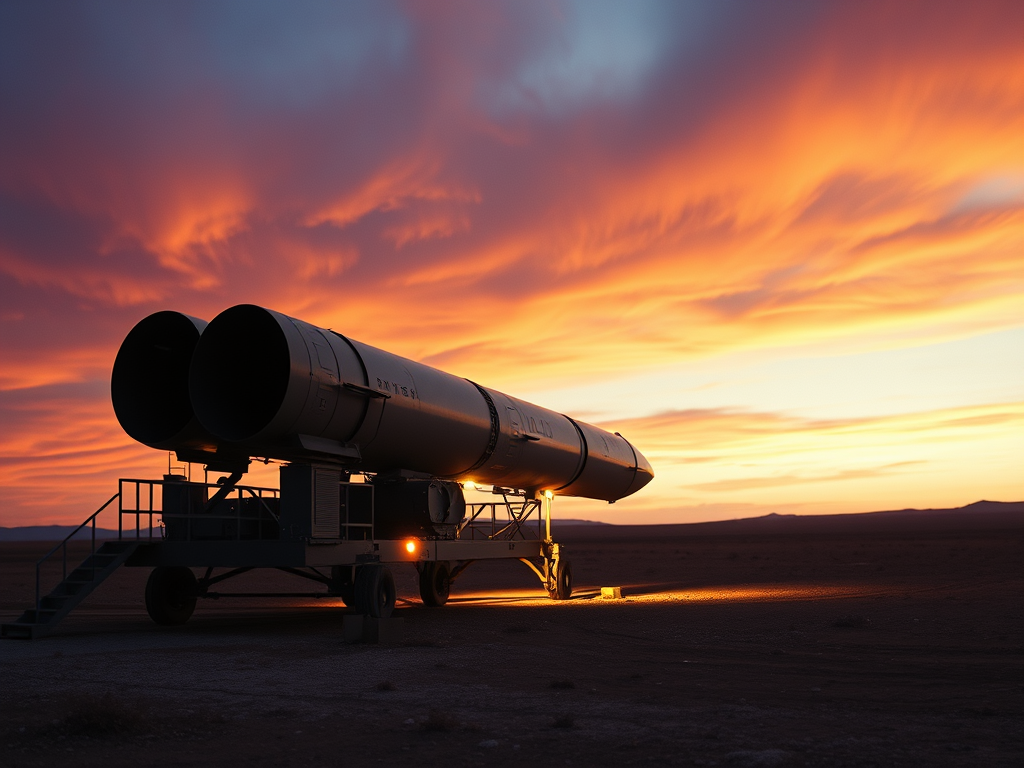
The Cold War was more than just an ideological struggle. It was between the capitalist West, led by the United States, and the communist East, led by the Soviet Union. It was also a technological race that played out both on Earth and in space. This race pushed the world to the brink of disaster. It also laid the groundwork for modern advancements. Two key arenas of this competition were the arms race and the space race. Both increased tensions, reshaped global politics and changed the course of history. In this blog, we’ll examine how these two races defined Cold War rivalry. They heightened the stakes for global security.
Follow us on Instagram, Facebook and LinkedIn.
The Arms Race: A Race to Destruction
The Beginnings: Nuclear Monopoly and the Soviet Challenge
The origins of the Cold War arms race can be traced back to the end of World War II. The United States was the first and, for a short time, the only country with nuclear weapons. Its use of atomic bombs on Hiroshima and Nagasaki in 1945 sent a strong message of military superiority. However, this nuclear monopoly didn’t last long. In 1949, the Soviet Union successfully tested its own atomic bomb, breaking the U.S.’s dominance and marking the beginning of the nuclear arms race.
The Hydrogen Bomb and ICBMs: The Stakes Get Higher
By the 1950s, the arms race escalated with the development of the hydrogen bomb (H-bomb). This weapon was far more powerful than the atomic bomb. The USA and the USSR quickly moved to build larger, more destructive nuclear arsenals. This wasn’t just a matter of having more bombs. It was about who could develop the most devastating technologies the fastest. This competition led to the creation of Intercontinental Ballistic Missiles (ICBMs). These are long-range missiles capable of delivering nuclear warheads to distant targets within minutes. By the late 1950s, both sides had ICBMs, making the threat of nuclear annihilation more real than ever.
The doctrine of Mutually Assured Destruction (MAD) soon took hold. The idea was simple but terrifying: if either the U.S. or the USSR launched a nuclear attack, the other would retaliate with equal or greater force. This retaliation would ensure the destruction of both nations. This kept both superpowers in a constant state of tension, where even the smallest conflict could escalate into global catastrophe.
Related | The Cold War: Origins, Impact and Legacy
The Space Race: A New Frontier
Sputnik and the Dawn of the Space Age
The arms race was a symbol of destruction. The space race represented the Cold War’s other side: technological innovation and the quest for prestige. It began in earnest in 1957 when the Soviet Union launched Sputnik, the first artificial satellite, into space. Sputnik’s successful launch sent shockwaves through the U.S., which had assumed its technological superiority would extend into space.
This was more than just a scientific achievement—it was a demonstration of Soviet power. The same technology that could send a satellite into space could also launch nuclear missiles across continents. The launch of Sputnik triggered a fierce response from the U.S., marking the start of a full-scale space race.
The U.S. Response: NASA and the Moon Landing
In response to Sputnik, the U.S. accelerated its space program, creating NASA in 1958 to oversee space exploration efforts. The early years of the space race were filled with Soviet victories. They launched the first living creature into space (Laika the dog in 1957). They also launched the first human (Yuri Gagarin in 1961) and the first woman (Valentina Tereshkova in 1963).
Related | The Legacy of US President John F. Kennedy: Achievements, Impact and Historical View
However, the tide turned in 1969 when the U.S. achieved what is arguably the crowning achievement of the space race: Apollo 11 and the moon landing. On July 20, 1969, astronaut Neil Armstrong became the first human to set foot on the moon. He famously declared, “That’s one small step for man, one giant leap for mankind.” The moon landing was a major victory for the U.S. and solidified its status as the leader in space exploration.
How the Arms Race and Space Race Heightened Cold War Tensions
While the arms race and space race were focused on technological supremacy, they had profound political and psychological effects. Each technological leap was interpreted as a threat to global security, and the competition between the U.S. and USSR became a symbol of their broader ideological struggle. The arms race, in particular, generated a combination of fear and paranoia. Civil defence drills and “duck and cover” exercises became common in the U.S., while both superpowers invested billions in maintaining and modernising their nuclear arsenals.
Related | From Brinkmanship to Détente: Cooperation in the Cold War (1963–1979)
The space race, while less immediately threatening than the arms race, still stoked tensions by demonstrating each nation’s technological prowess. The Soviet Union’s early victories in space raised questions in the West about whether communism might be more successful.
In both races, propaganda played a huge role. Each side touted its achievements as evidence of its system’s superiority. For the U.S., the moon landing wasn’t just about beating the Soviets to the moon—it was a symbolic victory for democracy. For the USSR, every successful satellite or space mission was framed as proof of the superiority of the Communist Party.
Conclusion: A Legacy of Competition
The arms race and space race were defining features of the Cold War. They heightened tensions and fuelled the competition between the U.S. and the USSR. The fear of nuclear war loomed large. The desire for technological supremacy drove both nations to innovate at a breathtaking pace. Today, we live in a world shaped by these events. The arms race left behind a legacy of nuclear proliferation and the constant threat of nuclear conflict. Meanwhile, the space race laid the foundations for modern space exploration, satellite technology and even global communications.
In hindsight, both races were more than just competitions—they were expressions of the broader Cold War struggle for global dominance. While the Cold War may have ended, its technological battles continue to influence geopolitics and technological advancement today.
For a comprehensive overview of the Cold War’s pivotal moments, be sure to check out our summary blog. The blog links to each detailed article.
Book your online or in-person history tuition session today.
Unlock our exclusive resources in our Mission Control hub.
Leave a Reply to John Glenn: From Ohio Boy to Orbit and Beyond – Apollo ScholarsCancel reply