The Cold War: A Comprehensive Overview of Key Events and Turning Points
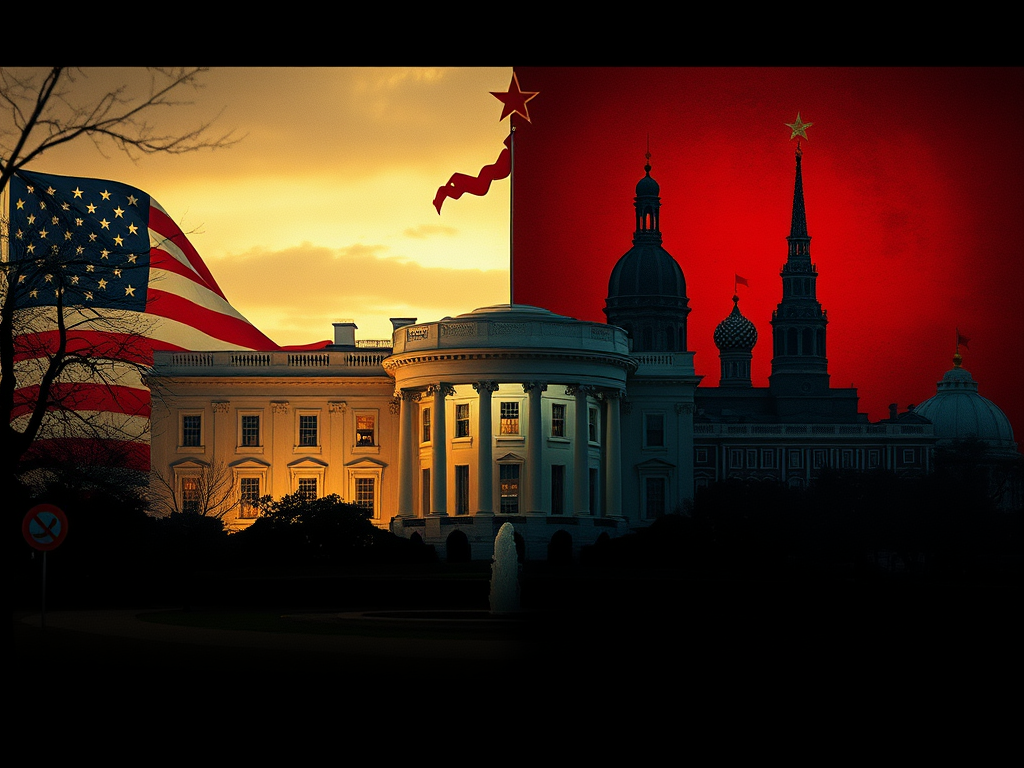
AI Disclosure: This image was synthetically generated by AI for educational purposes. Its inclusion in this content, whether accessed via free or gated tiers, does not constitute or imply an endorsement, sponsorship, or affiliation with any third party, brand, or individual. All usage is subject to our Brand Disclaimer.
The Cold War was one of the most significant geopolitical conflicts of the 20th century. Lasting from the end of the Second World War until the collapse of the Soviet Union in 1991, it shaped international relations, military strategy and global politics for almost five decades.
Unlike a conventional war, the Cold War rarely involved direct military conflict between the United States and Soviet Union. Instead, the two superpowers competed through ideological rivalry, nuclear weapons, military alliances, proxy wars, economic pressure and political influence.
From the division of Europe and the Berlin Blockade to the Korean War, Cuban Missile Crisis, Vietnam War, détente and the eventual collapse of communism in Eastern Europe, the Cold War repeatedly brought the world close to confrontation.
This guide provides an overview of the major Cold War events and turning points, with links to more detailed Apollo Scholars resources on each topic.
Cold War Revision Guide: For a more detailed examination-focused guide covering 1945–1991, explore the Apollo Scholars Cold War Revision Guide.
The Cold War developed gradually rather than beginning on a single date. Therefore, understanding the conflict requires following the major developments that transformed the relationship between the former wartime allies.
1. The Origins of the Cold War: 1945–1949
The Cold War began as the Grand Alliance broke apart after the Second World War.
Although the United States, Britain and the Soviet Union had cooperated against Nazi Germany, serious disagreements emerged once the common enemy had disappeared.
At the Yalta and Potsdam Conferences, the Allies disagreed over the future of Germany and Eastern Europe. Stalin wanted to protect Soviet security and maintain friendly governments along the USSR’s western border, while the United States increasingly promoted democratic government and economic cooperation.
Tensions intensified as the Soviet Union established communist governments across Eastern Europe.
Meanwhile, the United States adopted a policy of containment, designed to prevent further communist expansion.
These developments created the foundations for the division of Europe and the wider Cold War.
2. The Iron Curtain and Soviet Control of Eastern Europe
As Soviet influence expanded across Eastern Europe, the division between the communist East and capitalist West became increasingly clear.
In his famous Iron Curtain speech in 1946, Winston Churchill warned that an ideological divide had descended across Europe.
The United States responded to growing Soviet influence through policies including the Truman Doctrine and Marshall Plan.
While the Truman Doctrine promised support for governments threatened by communism, the Marshall Plan provided economic assistance to help rebuild Western Europe.
The Soviet Union responded by tightening its control over Eastern Europe and establishing its own economic and political structures.
Consequently, Europe became divided into competing spheres of influence.
Berlin became one of the first major flashpoints of the Cold War.
Although Germany had been divided into occupation zones, Berlin itself was located deep inside the Soviet occupation zone.
In 1948, the Western Allies introduced a new currency into their occupation zones. Stalin responded by imposing the Berlin Blockade, cutting off Western land access to West Berlin.
The United States and its allies refused to abandon the city.
Instead, they organised the Berlin Airlift, supplying West Berlin by air for almost a year.
The Soviet Union eventually lifted the blockade in May 1949.
The crisis demonstrated that neither side was prepared to surrender its position in Berlin. It also reinforced the division of Germany, with the Federal Republic of Germany (West Germany) and German Democratic Republic (East Germany) emerging in 1949.
The Korean War transformed the Cold War from a predominantly European confrontation into a global conflict.
After the Second World War, Korea had been divided along the 38th parallel. North Korea developed under communist leadership, while South Korea developed as an anti-communist state supported by the United States.
On 25 June 1950, North Korean forces invaded South Korea.
The United States and United Nations intervened to defend South Korea. Initially, UN forces were pushed back towards the Pusan Perimeter. However, General Douglas MacArthur’s successful Inchon Landing dramatically changed the course of the war.
When UN forces advanced towards the Chinese border, China entered the conflict, pushing UN forces back.
The war eventually settled into a stalemate close to the original dividing line.
The Korean Armistice Agreement was signed in 1953. However, no formal peace treaty followed.
The Cold War also became a competition over technology, military power and scientific achievement.
Both superpowers developed increasingly powerful nuclear weapons. The United States and Soviet Union built huge arsenals capable of destroying each other several times over.
The development of intercontinental ballistic missiles (ICBMs) increased the threat because nuclear weapons could potentially reach targets thousands of miles away.
Meanwhile, the Space Race became another arena for competition.
The Soviet Union shocked the United States by launching Sputnik in 1957, the world’s first artificial satellite.
The United States responded by increasing investment in science, technology and education.
The Space Race eventually culminated in the American Moon landing of 1969.
Therefore, technological competition became an important part of the wider struggle between capitalism and communism.
The Cuban Missile Crisis represented perhaps the most dangerous moment of the entire Cold War.
After Fidel Castro’s communist revolution in Cuba, relations between Cuba and the United States deteriorated rapidly.
The Soviet Union subsequently placed nuclear missiles in Cuba, just 90 miles from the American mainland.
When American intelligence discovered the missiles in October 1962, President John F. Kennedy faced an extraordinarily difficult decision.
Rather than immediately launching an attack, Kennedy imposed a naval quarantine around Cuba and demanded the removal of the missiles.
For 13 tense days, the world appeared to be on the brink of nuclear war.
Eventually, Khrushchev agreed to remove the missiles in return for American commitments concerning Cuba and the secret removal of US missiles from Turkey.
The crisis demonstrated the catastrophic dangers of nuclear confrontation.
It also encouraged both superpowers to improve communication and reduce the risk of future misunderstandings.
Following the Cuban Missile Crisis, both superpowers recognised the dangers of repeatedly pushing the Cold War towards nuclear confrontation.
As a result, relations gradually moved towards détente, meaning a relaxation of tensions. The two sides introduced measures designed to improve communication and limit aspects of the nuclear arms race.
The Hotline Agreement established a direct communication link between Washington and Moscow.
Meanwhile, the SALT negotiations attempted to limit strategic nuclear weapons.
The Helsinki Accords of 1975 also promoted greater cooperation and included commitments concerning European security and human rights.
Nevertheless, détente did not end the Cold War.
Both superpowers continued to compete for influence around the world, particularly through proxy conflicts.
The Vietnam War demonstrated the continuing importance of Cold War competition in Asia.
North Vietnam, led by the communist government of Ho Chi Minh, sought to reunify Vietnam under communist rule. The United States supported South Vietnam because American leaders feared that communist expansion would spread throughout Southeast Asia.
President Lyndon B. Johnson dramatically increased American involvement following the Gulf of Tonkin Incident in 1964.
However, the United States struggled to defeat North Vietnamese and Viet Cong forces.
The Tet Offensive of 1968 became a major turning point. Although communist forces suffered heavy casualties, the offensive undermined American claims that victory was close.
When Richard Nixon became president, he introduced Vietnamisation, gradually transferring responsibility for the fighting to South Vietnamese forces.
The Paris Peace Accords were signed in 1973, leading to the withdrawal of American forces.
Two years later, North Vietnamese forces captured Saigon.
Vietnam therefore demonstrated the limits of American military power and weakened confidence in the policy of containment.
9. Gorbachev and the End of the Cold War: 1985–1991
By the 1980s, the Soviet Union faced serious economic and political problems.
When Mikhail Gorbachev became Soviet leader in 1985, he introduced two major reforms: glasnost, meaning openness, and perestroika, meaning restructuring.
Gorbachev also sought better relations with the United States.
He held a series of summits with President Ronald Reagan, culminating in the INF Treaty of 1987, which eliminated an entire class of nuclear missiles.
More importantly, Gorbachev became increasingly unwilling to use Soviet military force to preserve communist governments in Eastern Europe.
In 1989, communist regimes across Eastern Europe collapsed.
The Berlin Wall fell in November 1989, becoming one of the most powerful symbols of the Cold War’s collapse.
Looking at individual events can make the Cold War appear like a series of disconnected crises.
However, these events formed part of a much larger struggle.
The Berlin Blockade demonstrated the division of Europe. The Korean War showed that Cold War competition could become a global military conflict. The Cuban Missile Crisis exposed the dangers of nuclear brinkmanship.
Later, détente demonstrated that the superpowers could negotiate despite their ideological differences.
Finally, the reforms of Gorbachev and the collapse of communist governments in Eastern Europe brought the conflict towards its conclusion.
The most important point for students to remember is that the Cold War constantly changed.
It moved between periods of confrontation and cooperation, while the underlying rivalry between the United States and Soviet Union remained.
Key Cold War Themes for Students
When revising the Cold War, it helps to organise events around several recurring themes.
Ideological conflict
The United States promoted capitalism and liberal democracy, while the Soviet Union promoted communism.
Containment
The United States attempted to prevent further communist expansion through economic, political and military measures.
Nuclear weapons
The arms race created the possibility of Mutually Assured Destruction (MAD) and forced both superpowers to consider the consequences of direct conflict.
Proxy warfare
The United States and Soviet Union often supported opposing sides without directly fighting one another.
Examples include Korea, Vietnam and Afghanistan.
Détente
The superpowers occasionally moved towards cooperation when the risks of confrontation became too great.
The limits of superpower power
Events such as Vietnam demonstrated that enormous military resources did not guarantee political victory.
The collapse of communism
Economic problems, political reform, nationalist movements and changing Soviet policy contributed to the collapse of communist rule in Eastern Europe and the Soviet Union.
Evaluation: How Significant Were the Major Turning Points?
Historical Evaluation
The most significant turning point: The Cuban Missile Crisis of 1962 can be considered one of the most important turning points because it demonstrated the catastrophic risks of nuclear brinkmanship. Both superpowers subsequently had greater incentives to improve communication and manage their rivalry.
The most important military conflict: The Korean War demonstrated that the Cold War could become a large-scale conventional conflict while remaining below the level of direct US-Soviet war.
The most important failure of containment: The Vietnam War exposed the limitations of American military power and demonstrated that local nationalism could be more complicated than the simple communist-versus-capitalist framework suggested.
The most important development in ending the Cold War:Gorbachev’s reforms were crucial because his decision to reduce confrontation and avoid military intervention in Eastern Europe allowed communist governments to collapse without the Soviet Union launching a major military response.
Overall judgement: No single event ended the Cold War. Instead, the conflict developed through decades of confrontation, negotiation, economic pressure, ideological competition and political change. The final collapse resulted from the interaction of internal Soviet weaknesses, Gorbachev’s reforms, the decline of Soviet control in Eastern Europe and changing relations with the United States.
Key Questions for Revision
Why did the Cold War begin?
The Cold War developed because wartime cooperation between the United States and Soviet Union collapsed amid ideological differences, security concerns and competing visions for post-war Europe.
Why was Berlin important?
Berlin became a symbol of the wider division between communist Eastern Europe and capitalist Western Europe.
Why was the Korean War significant?
It transformed the Cold War into a global military conflict and demonstrated the importance of containment.
Why was the Cuban Missile Crisis so important?
It brought the world closer to nuclear war than almost any other Cold War crisis.
Why did détente develop?
Both superpowers recognised the dangers and costs of continued confrontation and sought greater stability through diplomacy and arms control.
Why did the Vietnam War matter?
It exposed the limitations of American power and damaged public confidence in US foreign policy.
Why did the Cold War end?
The Cold War ended because several factors combined, including Soviet economic weakness, Gorbachev’s reforms, the collapse of communist governments in Eastern Europe and the eventual dissolution of the Soviet Union.
Conclusion
The Cold War was not a single conflict but a constantly changing struggle between two competing superpowers and their allies.
From the division of Europe after 1945 to the collapse of the Soviet Union in 1991, the conflict shaped politics, economics, military strategy and international relations across the world.
The Berlin Blockade, Korean War, Cuban Missile Crisis and Vietnam War demonstrated the dangers of confrontation. Meanwhile, détente, arms-control agreements and the diplomacy of Gorbachev and Reagan demonstrated that the superpowers could also manage their rivalry through negotiation.
Ultimately, the Cold War ended not because one side simply defeated the other on the battlefield, but because the Soviet system became increasingly difficult to sustain.
For students, the central lesson is therefore to look beyond individual dates and events. The strongest understanding comes from recognising the connections between ideology, containment, nuclear weapons, proxy wars, diplomacy, economic pressure and political change.
How Apollo Scholars Can Help
Understanding the Cold War requires students to connect events rather than simply memorise them.
At Apollo Scholars, we help History students develop that deeper understanding through personalised tuition, exam preparation and essay-writing support.

Leave a Reply