
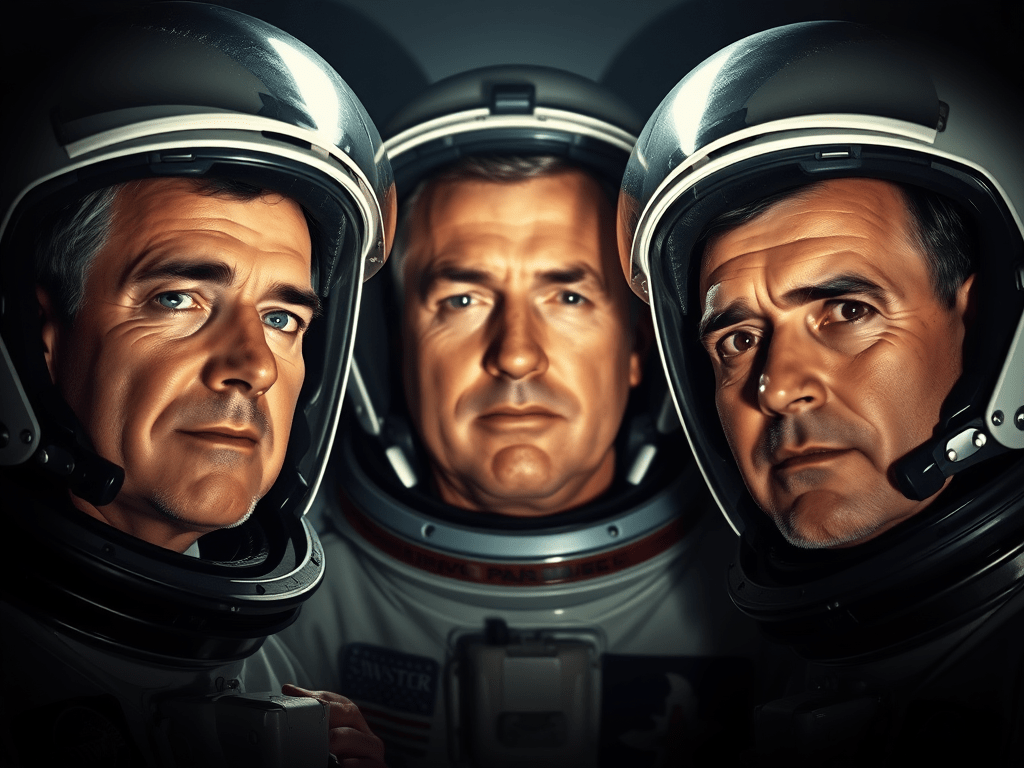
Key Facts: Apollo 1
- Date of tragedy: 27 January 1967
- Location: Cape Kennedy, Florida, USA
- Mission: Apollo 1 (first crewed test of the Apollo spacecraft)
- Astronauts:
- Virgil “Gus” Grissom
- Ed White
- Roger B. Chaffee
- Outcome: Complete redesign of the Apollo spacecraft and safety protocols
Context: The Cold War and the Space Race
In the 1960s, the United States and the Soviet Union were engaged in the Space Race, a competition to demonstrate technological and ideological superiority. The USSR had achieved early successes:
- Sputnik (1957): The first artificial satellite in space.
- Yuri Gagarin (1961): First human to orbit the Earth.
In response, US President John F. Kennedy set a bold challenge:
“We choose to go to the Moon … before this decade is out.”
– US President John F. Kennedy
NASA was under pressure to develop the Apollo spacecraft quickly. Apollo 1 was intended as the first crewed test flight, a vital step toward reaching the Moon.
The Apollo 1 Crew: Pioneers of Space Exploration
- Virgil “Gus” Grissom: Experienced pilot and one of NASA’s Mercury Seven astronauts, known for his bravery and commitment to safety.
- Ed White: First American to perform a spacewalk, admired for calmness under pressure.
- Roger B. Chaffee: Young naval aviator and engineer, representing the new generation of astronauts.
These men were pioneers who accepted extraordinary risks to advance human knowledge.
The Fire: What Happened
During a “plugs-out” test, the Apollo capsule was filled with pure oxygen under high pressure. The cabin included flammable materials, and the hatch opened inward, which made escape nearly impossible.
At 6:31 p.m., a spark, likely from faulty wiring, ignited the oxygen-rich environment. Fire spread rapidly, and the crew attempted to escape. Grissom’s final words were recorded:
“Fire in the cockpit!”
The fire lasted less than 30 seconds, leaving a profound impact on NASA and the public.
Aftermath: Lessons Learned
The Apollo 1 tragedy prompted a thorough investigation, which found:
- Faulty electrical wiring and unsafe test conditions.
- Flammable cabin materials that accelerated the fire.
- Hatch design that prevented rapid escape.
The investigation revealed that pressure to meet deadlines had contributed to the accident. NASA had to reconsider how it balanced speed with safety.
Despite the loss, Apollo 1 became a turning point for the space programme:
- Redesign of the spacecraft: Outward-opening hatch, fire-resistant materials, safer wiring and oxygen systems.
- New safety culture: Engineers were encouraged to raise concerns, and safety became a priority over speed.
- Path to future success: Apollo 7 (1968) became the first successful crewed mission, paving the way for Apollo 11’s Moon landing in 1969.
NASA Astronaut Frank Borman later reflected that while some feared the Apollo 1 fire might end the missions, in reality, it highlighted the problems that had to be fixed for Apollo to succeed.
Educational Perspective: Understanding the Tragedy
The tragedy revealed:
- The human cost of rapid technological advancement during the Cold War.
- How tragedy can spark critical reforms, improving safety for future missions.
- The importance of learning from mistakes in high-risk fields like space exploration.
Apollo 1 reminds us that achievements like the Moon landing were built not only on innovation but also on lessons learned through failures.
Legacy: The Key Takeaway
The Apollo 1 astronauts never left Earth, but their legacy shaped every mission that followed. The tragedy forced NASA to prioritise safety and careful engineering, making the Moon landing possible. For students, Apollo 1 demonstrates:
- The risks of Cold War competition.
- How failure can lead to improvement and eventual success.
- The human stories behind technological achievements.
NASA’s tribute captures the essence of their sacrifice:
“We’ve always known that something like this would happen sooner or later, but it’s not going to be permitted to stop the program… Although everyone realised that someday space pilots would die, who would have thought the first tragedy would be on the ground?”
James E. Webb
NASA Administrator
Final Thought: Apollo 1 is a story of courage, sacrifice and learning. It reminds us that progress often comes with risk, and that behind every historic achievement are individuals whose contributions may never leave the ground but whose impact reaches the stars.

“Apollo 1 reminds us that every great leap in science carries risk, yet it is through facing and learning from these challenges that humanity moves forward. The Apollo missions of the 1960s sparked a wave of discovery and exploration, inspiring a generation to dream bigger and reach further. They showed young people the power of curiosity, courage and innovation, and continue to serve as a reminder that education and exploration go hand in hand. Today, we hope their story ignites a lifelong passion for learning and fuels the next generation of explorers to push the boundaries of what is possible.”
Matt
Founder, Apollo Scholars
Disclaimer: There is no affiliation, association, or connection in any way between Apollo Scholars and NASA. Any references to NASA in this article are for educational and historical purposes only and do not imply an official relationship with Apollo Scholars.


Leave a reply to The Three Astronauts Who Were Bigger Than Rockstars: The Apollo 11 Mission – Apollo Scholars Cancel reply