
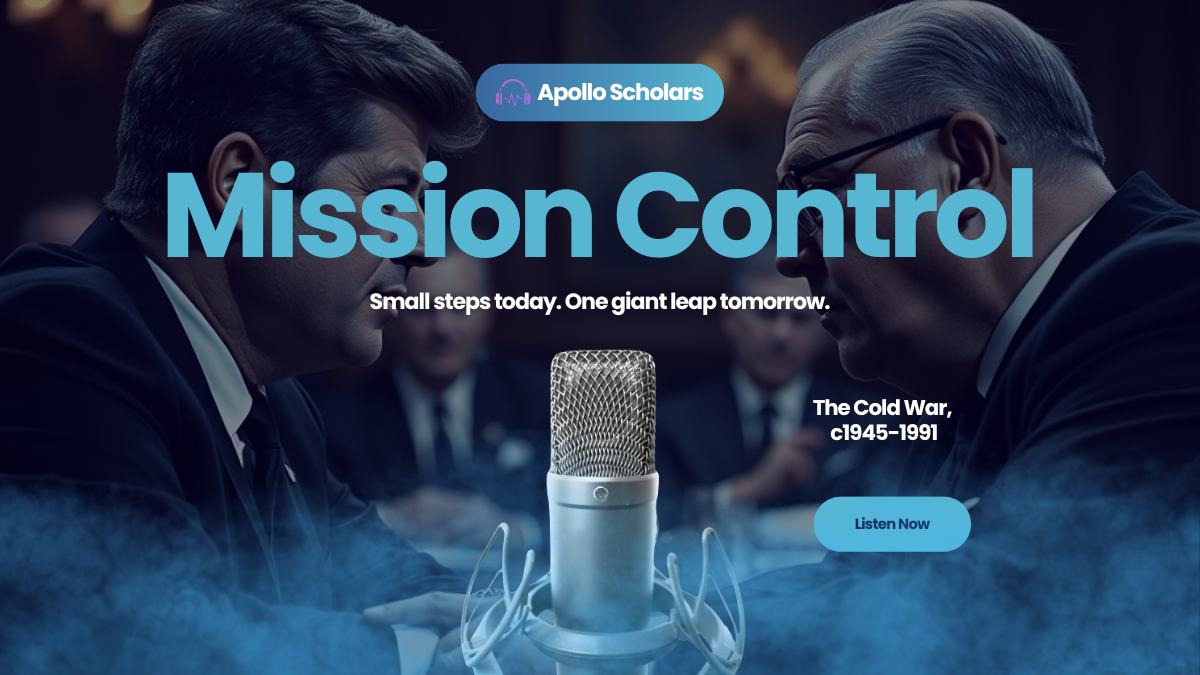
The second full episode of Mission Control is here, and this time, we are taking on the Cold War.
Spanning almost half a century, the Cold War shaped international politics, transformed societies, fuelled proxy wars and brought the world dangerously close to nuclear conflict.
However, a conflict of this scale needed both fuel and an ignition. The fuel had been accumulating for years: ideological rivalry, competing security interests, mutual distrust and the power vacuum left by the Second World War. After 1945, those tensions were finally ignited as the United States and Soviet Union emerged as rival superpowers. In this latest Cold War podcast episode from Apollo Scholars, we explore where that fuel came from, what finally lit the fuse, how the Cold War developed and how it ultimately came to an end.
After exploring Hitler’s Rise to Power in Episode 001, we are turning to one of the defining conflicts of the twentieth century.
From the breakdown of the Grand Alliance in 1945 to the collapse of the Soviet Union in 1991, we will explore the crises, confrontations, rivalries and individuals that shaped the Cold War along the way.
How did it begin? Why did it last so long? And how did two superpowers spend almost fifty years locked in a struggle capable of destroying the world, without ever directly going to war with one another?
That is the story we are exploring in Episode 002.
AI Disclosure: This episode has been created with the assistance of AI tools as part of the Apollo Scholars content production process. All historical content has been reviewed and edited for accuracy.
Welcome to Mission Control
Mission Control is the educational podcast from Apollo Scholars, exploring the ideas, events and stories behind the subjects you study.
Across the series, we will explore History, Economics, Business, English Literature and English Language, breaking down complicated topics and making them easier to understand, remember and connect together.
Mission Control is not just about revision.
Whether you are studying for an exam, interested in history, or simply want to understand more about the world around you, each episode is designed to tell a story first.
After all, history is not just about remembering what happened.
It is about understanding why.
Our Second Topic: The Cold War, c1945–1991
For our second full episode, we are tackling the Cold War.
Unlike a conventional war, the United States and Soviet Union never directly fought one another in a full-scale conflict. Instead, they spent almost fifty years competing for global influence through diplomacy, military alliances, economic power, espionage, propaganda, technological competition and proxy wars.
All the while, both sides possessed nuclear weapons capable of destroying civilisation.
This episode explores how that extraordinary situation developed, and how the world repeatedly came close to disaster without the two superpowers ever going directly to war.
We have divided the story into six eras, taking you from the breakdown of the wartime alliance in 1945 through to the collapse of the Soviet Union in 1991.
From the Grand Alliance to the Korean War
The Cold War did not begin with a single declaration of war.
It emerged from the collapse of the alliance that had defeated Nazi Germany.
At Tehran, Yalta and Potsdam, Roosevelt, Churchill, Stalin and Truman attempted to decide what the post-war world would look like. However, beneath the agreements were fundamentally different visions of the future.
The United States and its allies wanted political pluralism and self-determination in Europe. Stalin wanted security, influence and governments in Eastern Europe that would not threaten the Soviet Union.
As Germany was divided, Eastern Europe came increasingly under Soviet control, while the United States responded with the Truman Doctrine and Marshall Plan.
By 1949, Europe was becoming divided into rival blocs. NATO was created in the West, while the Soviet atomic bomb ended the American nuclear monopoly.
Then came Korea.
The Korean War transformed the Cold War from a political and ideological confrontation into a heavily militarised global struggle. It demonstrated just how dangerous the rivalry between the superpowers could become.
From Sputnik to the Cuban Missile Crisis
The 1950s saw the Cold War spread further around the world.
The Soviet launch of Sputnik 1 in 1957 demonstrated that Moscow possessed the technological capability to put an object into orbit. It highlighted the growing significance of long-range missile technology.
Meanwhile, crises in Hungary and Berlin demonstrated the limits of Soviet willingness to allow Eastern European states to break away from its control.
Then came Cuba.
In October 1962, the United States discovered Soviet nuclear missiles being installed in Cuba. President John F. Kennedy faced an extraordinary choice: attack the missile sites, accept the Soviet deployment, or find another way out.
For thirteen days, the world waited.
Beneath the surface, the situation was even more dangerous than many people realised.
Our episode opens in the Sargasso Sea on 27 October 1962, aboard the Soviet submarine B-59.
American destroyers were dropping small depth charges intended to force the submarine to surface. However, the crew did not know that these were warning signals rather than an attempt to destroy them.
The submarine was carrying a nuclear torpedo.
With communications cut off, temperatures soaring and oxygen running low, the captain believed war might already have begun.
What happened next became one of the most extraordinary moments of the Cold War.
Vietnam, Prague and the Era of Détente
The Cuban Missile Crisis did not end the Cold War.
Instead, it changed the way both superpowers approached the possibility of direct confrontation.
A hotline was established between Washington and Moscow. The Partial Test Ban Treaty followed in 1963, and further agreements attempted to place limits on the nuclear arms race.
However, elsewhere, the Cold War continued with devastating consequences.
Vietnam became one of the most important conflicts of the era. The United States committed hundreds of thousands of troops, while North Vietnam received support from the Soviet Union and China.
At the same time, the Soviet Union faced challenges within its own sphere of influence.
In 1968, Alexander Dubček’s Prague Spring attempted to create what he called “socialism with a human face.” Warsaw Pact forces invaded Czechoslovakia, and Soviet leader Leonid Brezhnev subsequently articulated the principle that became known as the Brezhnev Doctrine.
Yet by the 1970s, the relationship between East and West began to change.
The period known as détente saw the superpowers attempt to manage their rivalry rather than constantly escalate it.
Nixon’s opening to China, SALT I, the Helsinki Accords and negotiations over nuclear weapons all reflected a new approach to Cold War diplomacy.
The Second Cold War
Détente did not last.
The Soviet invasion of Afghanistan in 1979 helped bring the period of cooperation to an end.
The United States responded with sanctions, a grain embargo and a boycott of the 1980 Moscow Olympics, while supporting Afghan resistance fighters.
When Ronald Reagan became president in 1981, American policy became more confrontational.
Reagan described the Soviet Union as an “evil empire”, increased defence spending and announced the Strategic Defence Initiative, popularly known as Star Wars.
Across the world, the Cold War continued to play out through proxy conflicts.
From Afghanistan and Angola to Nicaragua and Central America, the United States and Soviet Union supported opposing sides without directly fighting each other.
Meanwhile, political opposition was growing inside the Soviet bloc.
In Poland, the Solidarity movement challenged Communist rule. Across Eastern Europe, economic stagnation and political dissatisfaction were becoming increasingly difficult for Communist governments to contain.
Gorbachev and the End of the Cold War
By the middle of the 1980s, the Soviet Union was facing serious economic and political problems.
In 1985, Mikhail Gorbachev became Soviet leader and introduced a new approach.
Glasnost encouraged greater openness.
Perestroika attempted to restructure the Soviet economy and political system.
Gorbachev’s idea of “new thinking” fundamentally changed Soviet foreign policy.
Rather than trying to preserve Soviet control over Eastern Europe through force, Gorbachev increasingly accepted that those countries would have to determine their own futures.
The consequences were enormous.
In 1989, Communist governments across Eastern Europe began to collapse.
Poland held partially free elections. Hungary opened its border with Austria. The Berlin Wall fell on 9 November. Czechoslovakia experienced the Velvet Revolution. Romania’s Nicolae Ceaușescu was overthrown and executed.
The Cold War was disappearing before the world had even fully realised it was ending.
In December 1989, George H. W. Bush and Gorbachev met at Malta, where they described the Cold War as effectively over.
Germany reunified in October 1990.
Then, in August 1991, hardliners attempted to overthrow Gorbachev.
The coup failed, but Soviet authority was fatally weakened.
On 25 December 1991, Gorbachev resigned as President of the Soviet Union.
The following day, the USSR was formally dissolved.
After almost half a century, the Cold War was over.
Why Did the Cold War End?
One of the biggest questions surrounding the Cold War is not simply when it ended, but why.
Was it because Ronald Reagan outspent the Soviet Union?
Was it because the Soviet economy could no longer sustain the arms race?
Was it because Communist ideology had lost its appeal?
Or was Gorbachev himself the decisive factor?
The answer is more complicated than any single explanation.
Economic stagnation, the burden of military spending, the war in Afghanistan, growing dissent in Eastern Europe and the weaknesses of the Soviet political system all played a role.
However, Gorbachev’s decision to reform the Soviet Union, and, crucially, to avoid using military force to preserve Communist governments in Eastern Europe, helped make the peaceful end of the Cold War possible.
That is one of the central questions we explore in this episode.
Listen to Mission Control Episode 002
The Cold War lasted from the aftermath of the Second World War to the final collapse of the Soviet Union.
It involved presidents and premiers, soldiers and spies, nuclear weapons and technological breakthroughs, revolutions and proxy wars.
However, at its heart was a fundamental question:
How could two superpowers remain locked in a struggle capable of destroying the world, without ever directly going to war with one another?
In Episode 002 of Mission Control, we explore that question across six eras.
Listen to Mission Control: The Cold War, c1945–1991.
[Insert Spotify Episode 002 embed here]
Whether you are studying the Cold War, revisiting it, or simply curious about one of the most important periods of the twentieth century, we hope this episode gives you a clearer picture of the bigger story.
Studying the Cold War?
If you are studying the Cold War at GCSE or A-Level, Apollo Scholars also offers revision resources designed to help you build a clearer understanding of the period.
Our Cold War resources explore the key events, individuals, ideas and turning points across the period, helping you connect individual topics to the wider story.
Buy our exclusive Cold War revision guide.
On the other hand, if you want more personalised support, Apollo Scholars offers 1:1 and small-group tuition across History, Economics, Business, English and Maths.
Book a tuition session with Apollo Scholars.
Welcome to Mission Control
The Cold War is one of the most complicated periods in modern history.
However, once you stop seeing it as a list of dates and start seeing the connections between events, the bigger picture begins to emerge.
From the breakdown of the Grand Alliance and the dawn of the nuclear age, through Korea, Cuba, Vietnam, détente and the Second Cold War, to Gorbachev, the fall of the Berlin Wall and the collapse of the Soviet Union.
Six eras. One story.
Welcome back to Mission Control.
Let’s get into it.
Share this episode
Enjoyed Episode 002? Share the episode with someone who might enjoy exploring the Cold War with us.
Subscribe to Mission Control
New episodes of Mission Control explore the stories, ideas and events behind the subjects you study.
Quick Links
More from Apollo Scholars
Explore our latest educational resources, revision guides, articles and podcast episodes across History, Economics, Business, English and Maths.
Leave a Reply